Showing posts with label language. Show all posts
Showing posts with label language. Show all posts
Sunday, April 21, 2013
But what are you REALLY trying to say?
“The Greek word baptize, which we borrow, was of very common use, as is seen in every period of Greek literature and was applied to a great variety of matters, including the most familiar acts of everyday life. It was thus a word which every Greek speaking hearer and reader in apostolic times would at once and clearly understand. It meant what we express by ‘immerse’ and kindred terms, and no one could then have thought of attributing to it a wholly different sense, such as ‘sprinkle’ or ‘pour’ without distinct explanation to that effect…..[speaking of protestants who sprinkle]. Such are the unavoidable defects of language, that strongly biased and ingenious minds can always cast some apparent doubt over the mean of the plainest words.” John Broadus


Friday, February 22, 2013
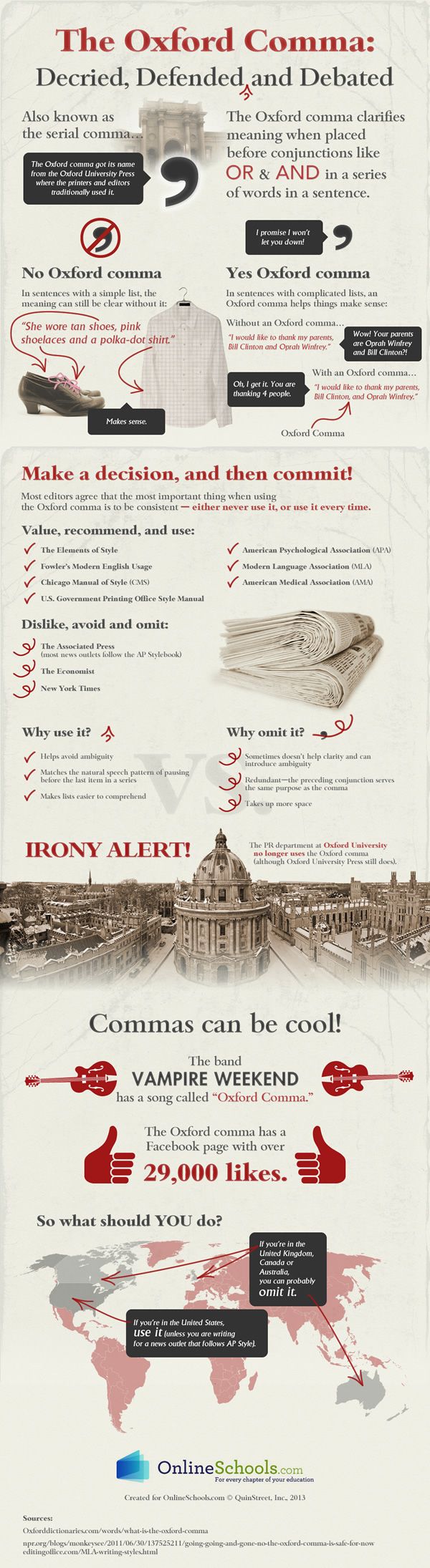
The Oxford Comma
I got a kick out of this. I am firmly on the affirmative with the Oxford Comma and I suppose we can still be friends if you wrong on this issue of vital importance. Enjoy a little gregarious grammatical guidance!

Tuesday, February 12, 2013
Exclamation of Joy
Ever wonder where the exclamation mark came from? Oh. Would you like to know anyway?
I found this interesting from the OUP word blog:
This is an excerpt from What Made the Crocodile Cry? by Susie Dent.
I found this interesting from the OUP word blog:
Both these punctuation marks [the ! and the ?] were originally manuscript abbreviations in Latin texts.
To take the exclamation mark first: it derives from a vertical version, written in the margins, of the Latin word Io, meaning ‘exclamation of joy’. The vertical stroke was the ‘I’ above the ‘o’, in which the ‘o’ eventually became a dot.
The question mark, meanwhile, goes back to the word Quaestio meaning ‘questioning, investigation’ and indicating a question. Quaestio was eventually abbreviated to a curly ‘q’ above the ‘o’, while the ‘o’ became a dot.
Why were these marks needed in the first place? Their prime function in Latin manuscripts was to show people the right intonation: a question, a surprise, a shout, etc. If you combine them you get a different effect: ?! delivers an immediate sense of incredulity: a little like smileys or emoticons in our text messages today.
This is an excerpt from What Made the Crocodile Cry? by Susie Dent.
Subscribe to:
Posts (Atom)