"Love not anything in this world so much that the loss of it would throw you quite off your guard, and make you abandon yourself to wild and extravagant methods of relief. Let your affections be so subdued and kept in good order that the common calamities of life may not utterly confound, though they may surprise you. If you place your whole happiness in any of the attainments of this world, you expose yourself to this bloody temptation when you suffer the loss of those idols." Isaac WattsHT: Paul Levy
Thursday, November 7, 2013
The Loss of an Idol


Saturday, October 19, 2013
Holy Scriptures
"The supreme judge, by which all controversies of religion are to be determined, and by which must be examined all decrees of councils, opinions of ancient writers, and doctrines of men and private spirits can be no other than the Holy Scripture, delivered by the Spirit. And in the sentence of Scripture we are to rest, for it is in Scripture, delivered by the Spirit, that our faith is finally resolved."1689 London Baptist Confession
"We believe that the Holy Bible was written by men divinely inspired, and is a perfect treasure of heavenly instruction; that it has God for its author, salvation for its end, and truth without any mixture of error for its matter; that it reveals the principles by which God will judge us; and therefore is, and shall remain to the end of the world, the true center of Christian union, and the supreme standard by which all human conduct, creeds, and opinions should be tried."The New Hampshire Baptist Confession, 1833
Doug
Thursday, October 10, 2013
Bold Sinner, Fearful Saint
“O how uncomely a sight is it to see, a bold sinner and a fearful saint, one resolved to be wicked, and a Christian wavering in his holy course; to see guilt put innocence to flight, and hell keep the field, impudently braving it with displayed banners of open profaneness; [to see] saints hide their colors for shame, or run from them for fear, who should rather wrap themselves in them, and die upon the place, than thus betray the glorious name of God, which is called upon by them to scorn of the uncircumcised. Take heart therefore, O ye saints, and be strong, your cause is good, God himself espouseth your quarrel, who hath appointed you his own Son, General of the field called “the Captain of our salvation’ . He shall lead you on with courage, and bring you off with honor.”
The Christian in Complete Armour - William Gurnall
Sunday, October 6, 2013
William Tyndale and Congregation: More than Defensible
William Tyndale in his translation of Matthew 16:18
rendered it this way, “And I say also unto thee, that thou art
Peter: and upon this rock I will build my congregation. And the gates of hell shall not prevail
against it.” David Daniell, author
of the introduction to the 1989 Yale University Press edition of the Tyndale
Bible said
“The Bishop of London hunted down and burned many thousands of Tyndale’s successive New Testaments and Pentateuch’s with fanatical thoroughness, a ruthlessness that seems close to hysteria – only a dozen in all survive. King Hevry VIII’s chancellor, Sir Thomas More, showed himself less than gentile, reasoned, saintly and urbane in his long, and indeed violent polemics against Tyndale. He calls him in his Confutation, ‘a beast’, as one of the ‘hell-hounds that the devil hath in his kennel’, discharging a ‘filthy foam of blasphemies out of his brutish beastly mouth’. Elsewhere, More calls him a deceiver, a hypocrite; puffed up with the poison of pride, malice and envy’. Yet the best that More, in all the great length of his tirades, can summon against Tyndale, when all is boiled down, is the he translated the Greed word for ‘elder’ as elder, not priest and the Greek word for ‘repentance’ as repentance, not do penance, the Greek word for ‘congregation’ as congregation not church…Even Erasmus, More’s friend, had translated the Greek ekklēsia, as congregation, not church. Every change that Tyndale makes is more than defensible: it is correct.”
Thursday, October 3, 2013
You Can't Please Everyone
Charles Spurgeon from his excellent book The Eccentric Preacher.
"He who hopes to preach so as to please everybody must be newly come into the ministry; and he who aims at such an object would do well speedily to leave its ranks. Men must and will cavil and object: it is their nature to do so. John came neither eating nor drinking; he was at once a Baptist and an abstainer, and nothing could be alleged against his habits, which were far removed from the indulgences of luxury: but this excellence was made his fault, and they said, "He hath a devil." Jesus Christ came eating and drinking, living as a man among men; and this which they pretended to desire in John became an offense in Jesus, and they libeled him as "a drunken man and a wine-bibber, a friend of publicans and sinners." Neither the herald nor his Master suited the wayward tastes of their contemporaries. Like children playing in the market-place, who would not agree about what the game should be, so were the sons of men in that generation. They rejected the messengers because they loved not the God who sent them, and they only pretended to object to the men because they dared not avow their enmity to their Master. Hence the objections were often inconsistent and contradictory, and always frivolous and vexatious."
Thursday, September 19, 2013
Sunday, September 15, 2013
It's Right There in the Text
I read one man’s commentary on Revelation who mocked men who take a literal interpretation of Revelation, describing the absurdity of believing in monstrous locusts and the like. Then, with presumably a straight face, in the next paragraph informs us that the locusts were symbols of “neo-orthodox seminary professors, the so-called higher critics of our day.”
Of course. I should have known, it's right there in the text.
Of course. I should have known, it's right there in the text.
Sunday, August 25, 2013
Take it to the Lord in Prayer
A couple years ago a started keeping a journal. Actually, I
have several notebooks that I write in, and they are in no particular order and there isn't much rhyme or reason to the system. It probably would have been better to
have one and start at the beginning and go to the end, but where is the fun in
that? Anytime I am reading, I have the notebook beside me to catch my
thoughts, jot memorable quotes, argue at length with the author, or apply what
I have learned. This has been a tremendous help in my devotional life by going
slowly through a book and writing down what I have learned or needed to apply
to my heart. You really should not read a book without a pen in hand.
The nice thing about doing this is going back through your notes. You can see how the Lord is bringing you along and remember things you forgot. I was reading through one of my journals and found this entry from a couple years ago when I was working my way through a puritan work.
Don’t hide your failures, faults, and sorrow from God. There
is a temptation to deeply bury our sin and our pain and to straighten up before
we go to God.
- You are not able to “hide” anything from God
- A Christian does not need to hide from God
- We do not need to fix ourselves before coming to Christ.
This is my temptation. That I’m too sad or to broken to
pray. But that is exactly when I need prayer most of all. I’m forgiven, loved,
and cared for by my Priest-King- Saviour. I shouldn’t try to atone for my own
sins with my tears and break the reed that Christ would not break. Yes,
confess. Mortify. Repent. But keep going till you reach the healing cross.
Saturday, August 24, 2013
Prayer and Care
"Carefulness and prayer cannot stand together. In every thing - great and small - let your requests be made known. They who by a preposterous shame or distrustful modesty, cover, stifle, or keep in their desires, as if they were either too small or too great, must be racked with care; from which they are entirely delivered, who pour them out with a free and filial confidence."John Wesley on Philippians 4:6
Sunday, August 11, 2013
In Christ
 “How do we receive those benefits which the Father bestowed on his only-begotten Son – not for Christ’s own private use, but that he might enrich poor and needy men? First, we must understand that as long as Christ remains outside of us, and we are separated from him, all that he has suffered and done for the salvation of the human race remains useless and of no value for us. Therefore, to share with us what he has received from the Father, he had to become ours and to dwell within us”
Book 3 of The Institutes of Christian religion
Picture courtesy of BGM.
John Piper well said:
 "Do you want to be free from the blinding effects of spiritual ignorance? Do you want to have the righteousness of Christ credited to your account and be accepted and acquitted and justified by God? Do you want to have the sanctifying power of Christ in your life helping you overcome canceled sin? Do you want to be delivered in the end from misery and death? If so – and I pray that you do – then cherish your union with Christ. Love being united to him. Grow in your grasp of these things. Live in them. Savor them. Carry them with you through the day. Make them your meditation day and night. Think often on what it means to be united to Christ. What it means that "by God's doing you are in Christ Jesus"
Saturday, August 10, 2013
I Rejoice; Rejoice Ye!
Alexander MacLaren on Philippians 4:4 from Expositions of Holy Scripture:
"It has been well said that this whole epistle may be summed up in two short sentences: ‘I rejoice’; ‘Rejoice ye!’ The word and the thing crop up in every chapter, like some hidden brook, ever and anon sparkling out into the sunshine from beneath the shadows. This continual refrain of gladness is all the more remarkable if we remember the Apostle’s circumstances. The letter shows him to us as a prisoner, dependent on Christian charity for a living, having no man like-minded to cheer his solitude; uncertain as to ‘how it shall be with me,’ and obliged to contemplate the possibility of being ‘offered,’ or poured out as a libation, ‘on the sacrifice and service of your faith.’ Yet out of all the darkness his clear notes ring jubilant; and this sunny epistle comes from the pen of a prisoner who did not know but that to-morrow he might be a martyr."
Thursday, July 18, 2013
An Odd Couple
The thought occurred to me, as it sometimes does, that there is a similarity between the Lutheran position on infant baptism and the Arminian position in decisional regeneration. If you have been reading the comments of prior posts, you may have a headache. Buy you also may have noticed many of the arguments of the pro-Luther party were lobbed in the general direction of the pro-Arminius constituency. I did observe something peculiar as I looked at the scorched remains of the Arminian straw man. He looked vaguely familiar.
Like I’ve noted before, there is a strange kinship between errors that, on the surface, seem to oppose one another. The antinomian is just as focused on the law as the legalist. One runs from the law, the other to the law, but for the sake of the law, they both do run.
The Lutheran and the Arminian have a strange kinship in regards to the sovereignty of God in salvation while they firmly deny the resemblance. Neither truly believes that God has the absolute freedom to choose who will be saved. Both believe it to be unjust and unfair for God to chose to show mercy on some and not others, to one degree or another. Whereas the Arminian applies this to all mankind, the Lutheran applies this to children. Both think they can do something to make God save someone. One calls sinners to the “altar” in the front of the church to make a decision while the other sprinkles water on a babies head. Both positions think that their actions will move God to save and both will call it grace. Both sides will get upset when you point out that this is a work, and both positions will say these things are done in faith. But when you boil it all down, making a decision is a work, and so is baptizing babies. What precedes faith will determine if you truly believe in grace. An odd couple.
The wreckage of decisional regeneration is no different than that of infant baptismal regeneration. In both instances a well meaning adult convinces a child that they are saved. The child takes their word for it and moves on, walking (or crawling) in darkness. A church full of false converts, nominal Christians who have taken the word of someone that they were baptized and believed the report that they repented of their sins and trusted in Christ. Do many later come to saving faith? Sure. Do many die in their sins trusting in the words of men assuring them that their decision saved them, or their baptism saved them? Sadly, yes.
Faith is substantive. True, living, God given faith awakens the dead spirit to life, opens the blind eyes to sight, and causes the dead sinner to see the kingdom of God and come to Jesus Christ. The Lutheran can parse words all day long, but an unconscious infant does not have faith, as faith is defined by the Bible (Hebrews 11:1). How many legs does a dog have if you call his tail a leg? He has four - calling a tail a leg doesn’t make it so. Redefining faith may help a well meaning parent or pastor to sleep at night, but it does not change God’s Word, nor does it regenerate the soul of the deceived.
This is an emotional issue, especially for parents of young children, like myself. If there were something I could do to save my children, I would do it - but it would do them no good to impose upon them a religious ritual that has no power to save and lie to them in order that I might feel better. The well meaning Arminian will do the same. They will ask the child if they love God and want to go to Heaven and then ask if they love Jesus and then tell them they are saved. This makes the parents rejoice, for a season, until they wonder why their teenager is cooking meth in the back yard instead of at Bible study.
My children are in God’s hands. Salvation is of the Lord. I tell my kids of the gospel daily. We have daily family worship and daily Bible reading. I pray for the salvation of my children. I do all that the Lord has required of me,all that I can do and their souls are in His hands - and there is no other place that I would rather they be. I desire nothing more than to see my children walk in the truth, but I cannot change the leopard's spots in family worship and only God’s grace can give a heart of flesh, faith, and true repentance. I preach the gospel, I call them to repentance - but their souls are not in my not in my hands, not in the hands of the church, but in the Hands of God.
Like I’ve noted before, there is a strange kinship between errors that, on the surface, seem to oppose one another. The antinomian is just as focused on the law as the legalist. One runs from the law, the other to the law, but for the sake of the law, they both do run.
The Lutheran and the Arminian have a strange kinship in regards to the sovereignty of God in salvation while they firmly deny the resemblance. Neither truly believes that God has the absolute freedom to choose who will be saved. Both believe it to be unjust and unfair for God to chose to show mercy on some and not others, to one degree or another. Whereas the Arminian applies this to all mankind, the Lutheran applies this to children. Both think they can do something to make God save someone. One calls sinners to the “altar” in the front of the church to make a decision while the other sprinkles water on a babies head. Both positions think that their actions will move God to save and both will call it grace. Both sides will get upset when you point out that this is a work, and both positions will say these things are done in faith. But when you boil it all down, making a decision is a work, and so is baptizing babies. What precedes faith will determine if you truly believe in grace. An odd couple.
The wreckage of decisional regeneration is no different than that of infant baptismal regeneration. In both instances a well meaning adult convinces a child that they are saved. The child takes their word for it and moves on, walking (or crawling) in darkness. A church full of false converts, nominal Christians who have taken the word of someone that they were baptized and believed the report that they repented of their sins and trusted in Christ. Do many later come to saving faith? Sure. Do many die in their sins trusting in the words of men assuring them that their decision saved them, or their baptism saved them? Sadly, yes.
Faith is substantive. True, living, God given faith awakens the dead spirit to life, opens the blind eyes to sight, and causes the dead sinner to see the kingdom of God and come to Jesus Christ. The Lutheran can parse words all day long, but an unconscious infant does not have faith, as faith is defined by the Bible (Hebrews 11:1). How many legs does a dog have if you call his tail a leg? He has four - calling a tail a leg doesn’t make it so. Redefining faith may help a well meaning parent or pastor to sleep at night, but it does not change God’s Word, nor does it regenerate the soul of the deceived.
This is an emotional issue, especially for parents of young children, like myself. If there were something I could do to save my children, I would do it - but it would do them no good to impose upon them a religious ritual that has no power to save and lie to them in order that I might feel better. The well meaning Arminian will do the same. They will ask the child if they love God and want to go to Heaven and then ask if they love Jesus and then tell them they are saved. This makes the parents rejoice, for a season, until they wonder why their teenager is cooking meth in the back yard instead of at Bible study.
My children are in God’s hands. Salvation is of the Lord. I tell my kids of the gospel daily. We have daily family worship and daily Bible reading. I pray for the salvation of my children. I do all that the Lord has required of me,all that I can do and their souls are in His hands - and there is no other place that I would rather they be. I desire nothing more than to see my children walk in the truth, but I cannot change the leopard's spots in family worship and only God’s grace can give a heart of flesh, faith, and true repentance. I preach the gospel, I call them to repentance - but their souls are not in my not in my hands, not in the hands of the church, but in the Hands of God.
Thursday, July 11, 2013
Does Titus 3:5 Teach Baptismal Regeneration and Support Infant Baptism?
In case you have missed the fun.
Part 1
Part 2
The book of Titus is a pastoral epistle, penned by Paul to instruct the Gentile minister on the work of pastoring a church. Chapter three, to which we have our present controversy, begins with the charge to Titus to preach that Christians are not to be subversive rebels, but live gently and meekly in this present evil world. We didn't always live a holy life, because we used to be foolish and disobedient, serving our lusts and pleasures. We used to be the hateful ones, living in hate, speaking hate, and hating one another (3:3). Christians are to live a life to the glory of God – a way that is contrary to the world, and a way that is contrary to our old lives. We also see a radical shift in worldviews. We used to believe one way and we used to do things a certain way, a wicked way, an evil way. Now, we don’t. How did that happen? How did we get from hateful and hating to gentle and meek?
Baptism is something God commands that we do. Our text, very clearly is telling us this washing has nothing to do with our works. Baptism is a work that we do in obedience to the Lord's command to be baptized. It is an act of obedience of the church to baptize believers. It is a good work, a righteous work to follow the Lord in baptism. But...
The only other time the word "washing" appears in the New Testament is in Ephesians 5:26, in which, speaking of the church, says God will "sanctify and cleanse it with the washing of the water by the Word.” It is the Word of God used to “wash” the sinner from the filth and defilement of sin. In fact, the Word of God is the instrument of God the Holy Spirit in salvation (James 1:18; Gal 3:1-2).
There is a twofold operation of the Holy Spirit in salvation, namely cleansing and renewal. Cleansing from the defilement of sin and the new birth. What does wash away our sins? The precious blood of Christ; Hebrews 9:22; Hebrews 12:24; Heb 9:13-14 For if the blood of bulls and of goats, and the ashes of an heifer sprinkling the unclean, sanctifieth to the purifying of the flesh: How much more shall the blood of Christ, who through the eternal Spirit offered himself without spot to God, purge your conscience from dead works to serve the living God?
Faith, which is the assurance of things hoped for, the conviction of things not seen, comes by hearing the Word of God. You cannot have faith without an object of hope and a conviction of the reality of the unseen. None of which applies to the infant. Repentance means to turn. No infant has ever repented of their sins upon their baptism. Infant baptizers get around this by redefining the words hearing, faith, repentance, and the Word. The Bible can mean anything if you get to define what the words mean.
************
Please keep the comments on topic. If you want to discuss THIS post and THIS passage, well by all means, comment away.
Thanks.
Part 1
Part 2
The book of Titus is a pastoral epistle, penned by Paul to instruct the Gentile minister on the work of pastoring a church. Chapter three, to which we have our present controversy, begins with the charge to Titus to preach that Christians are not to be subversive rebels, but live gently and meekly in this present evil world. We didn't always live a holy life, because we used to be foolish and disobedient, serving our lusts and pleasures. We used to be the hateful ones, living in hate, speaking hate, and hating one another (3:3). Christians are to live a life to the glory of God – a way that is contrary to the world, and a way that is contrary to our old lives. We also see a radical shift in worldviews. We used to believe one way and we used to do things a certain way, a wicked way, an evil way. Now, we don’t. How did that happen? How did we get from hateful and hating to gentle and meek?
Titus 4-7 But after that the kindness and love of God our Saviour toward man appeared, Not by works of righteousness which we have done, but according to his mercy he saved us, by the washing of regeneration, and renewing of the Holy Ghost; Which he shed on us abundantly through Jesus Christ our Saviour; that being justified by his grace, we should be made heirs according to the hope of eternal life.Not by our works, but by God’s work. We did not change ourselves but God changed us. Not because we are good, but because He is merciful. Not because of our work, because of His work. Not by decisions, water, church membership or any other thing we did, but he saved us by a supernatural work of the Holy Spirit, through Jesus Christ. We are not justified by baptism, but by Grace. Verses 8-12, show us that because of the work of God in salvation, we are urged to maintain good works. We do not do good works in order to be saved, but because we are saved, we do good works. One problem those that baptize infants have is applying faith and repentance to the unconscious infant. Our text illustrates repentance – turning from sin unto Christ. The thrust of the passage is we are saved from our evil ways unto good works. Something that actually happens on account of the new birth. This does not happen with the infant. Indeed, we are born into sin, but does the infant repent of the depraved nature and confess that he is born in guilty in Adam, before he is able to know his own name?
Baptism is something God commands that we do. Our text, very clearly is telling us this washing has nothing to do with our works. Baptism is a work that we do in obedience to the Lord's command to be baptized. It is an act of obedience of the church to baptize believers. It is a good work, a righteous work to follow the Lord in baptism. But...
(5) Not by works of righteousness which we have done, but according to his mercy he saved us, by the washing of regeneration, and renewing of the Holy Ghost; (6) Which he shed on us abundantly through Jesus Christ our SaviourVerse 5 makes it clear that it has nothing to do with our works that we are saved, but we do good works because of the good work of God in us. Titus 3:8 tells us that those who have believed are to do good works, not those who have been baptized. The washing and renewing are Divine acts of the Holy Spirit of God. The same is found in 1 Cor 6:9-11 Know ye not that the unrighteous shall not inherit the kingdom of God?..... And such were some of you: but ye are washed, but ye are sanctified, but ye are justified in the name of the Lord Jesus, and by the Spirit of our God. We were sinners, God cleaned us by His blood, now we are different. This verse has nothing to do with baptism. We are born again by the power of God. God using the instrument of His Word in regeneration.
The only other time the word "washing" appears in the New Testament is in Ephesians 5:26, in which, speaking of the church, says God will "sanctify and cleanse it with the washing of the water by the Word.” It is the Word of God used to “wash” the sinner from the filth and defilement of sin. In fact, the Word of God is the instrument of God the Holy Spirit in salvation (James 1:18; Gal 3:1-2).
1Pe 1:23-25 Being born again, not of corruptible seed, but of incorruptible, by the word of God, which liveth and abideth for ever. For all flesh is as grass, and all the glory of man as the flower of grass. The grass withereth, and the flower thereof falleth away: But the word of the Lord endureth for ever. And this is the word which by the gospel is preached unto you.
The same eternal Word that is preached is the gospel that is preached and believed. We evangelize by preaching God's Word. If God is pleased to use His Word to quicken a dead sinner to life, He will do so. Salvation comes by faith in Christ, through the preaching of the gospel, which is the power of God unto salvation. We are not born again by the power of baptism, but of the incorruptible seed, by the Word of God. Faith comes by hearing and hearing by the Word of God (Romans 10:17), not by the water. I believe it is incumbent upon those who believe this verse refers to Baptism to prove it. It is assumed this washing refers to baptism; however, since the whole of scripture teaches we are saved by Grace through faith, not by baptism, and that regeneration is a work of the Holy Spirit by His Sovereign will, not by the will of priest and parent. The sad thing is that those that baptize their babies lie to their children and tell them that they are saved because of what they did for them by having them baptized.
There is a twofold operation of the Holy Spirit in salvation, namely cleansing and renewal. Cleansing from the defilement of sin and the new birth. What does wash away our sins? The precious blood of Christ; Hebrews 9:22; Hebrews 12:24; Heb 9:13-14 For if the blood of bulls and of goats, and the ashes of an heifer sprinkling the unclean, sanctifieth to the purifying of the flesh: How much more shall the blood of Christ, who through the eternal Spirit offered himself without spot to God, purge your conscience from dead works to serve the living God?
Faith, which is the assurance of things hoped for, the conviction of things not seen, comes by hearing the Word of God. You cannot have faith without an object of hope and a conviction of the reality of the unseen. None of which applies to the infant. Repentance means to turn. No infant has ever repented of their sins upon their baptism. Infant baptizers get around this by redefining the words hearing, faith, repentance, and the Word. The Bible can mean anything if you get to define what the words mean.
************
Please keep the comments on topic. If you want to discuss THIS post and THIS passage, well by all means, comment away.
Thanks.
Tuesday, June 25, 2013
Does Colossians 2:11-13 Teach Baptisimal Regeneration?
There were heretics in the
church at Colosse and through vain deceit and the traditions of men, they were
leading men away from Christ in religion rather toward and after Christ in
truth. The issue in Colosse was the beginnings of what is known as Gnosticism.
The heresy was a mixture of a type of Judaism, mysticism, and philosophy that
corrupted the truth about Jesus Christ. Much like many of the cults today, the
wolves at Colosse were using the words of Christianity, but applying different
doctrines and philosophies and meanings to the words. They used familiar Christian
terms but applied their own definition.
There was the pre-Gnostic
idea of “the fullness”(Pleroma) which was "...the mediating eons or angel-powers or spiritual manifestations supposed to be intermediate between God and the world... the entire series of angels or eons, which filled the space or interval between a holy God and a world of matter, which was conceived of as essentially and necessarily evil." (ISBE). Paul declares that this is not fullness and true fullness is not found
in mysticism, or works, or ritual but Christ is the fullness: Christ is all and
we are complete and full in Him. Christ
is sufficient. Christ is fully God, Christ is the fullness of God in creation, Christ
is the fullness of God in redemption, Christ is the fullness of God in the
church, and Christ is the power and the purpose of living our lives. By
positively asserting Christ, Paul as inoculated the church from the heresies
that were (are are still) being taught. For the most part in this book, Paul battles the heresy by showing the truth.
When we get to second
chapter, Paul is dealing specifically with Christ and our salvation (Col. 2:9-10). How are we full and complete? Paul gives two
examples – not two options in verses 11-13. These examples are to illustrate
what the symbols were/are given to illustrate - that we are complete & made full
in Christ. The first example is showing the true meaning of circumcision and
what it actually represented.
Col 2:11 In whom also ye are circumcised with the circumcision made without hands, in putting off the body of the sins of the flesh by the circumcision of Christ:
Circumcision was never
given to impart faith. There was a twofold purpose for circumcision – one a
sign of the physical part of the covenant with Abraham (a land and a nation)
and the second part was a token of God’s work in redemption. When a person is born again, God takes away
the flesh, i.e. sin, the "old man". God preforms a circumcision of the heart. The Gentiles believers were
not encouraged to be circumcised but he is explaining from the physical token
what had happened to them spiritually by using the token that God had used with
Israel to demonstrate that very point. The covenant given to Abraham was based
upon the promise God gave to Abraham, not upon the works of the flesh (Gal.
3:17-19). Circumcision never conferred grace (Romans 4:8-10), it was a sign (Romans 4:11-12). This had always
been the spiritual aspect of circumcision (cf. Lev 26:41-42; Deut 30:5-6; Deut
10:12-17). In order to be a citizen of the nation of Israel and to partake of the inheritance of the land, one had to be circumcised, but this did not preform any spiritual work. The Old Testament taught the same principle as the new, a heart
circumcision (Ezk 11:10 and Col 2:11). However, circumcision never saved.
Moving on to Col. 2:12, we
see the second part of the same sentence giving the same thought.
Col 2:12 Buried with him in baptism, wherein also ye are risen with him through the faith of the operation of God, who hath raised him from the dead.
As circumcision is being used to illustrate a point, so is Baptism. It
has never been something that confers grace, but it is a picture of the work of
God in regeneration. We are buried under the water (immersed, not sprinkled)
and raised to walk in newness of life. The act of going under the water
pictures death, our death to sin and Christ’s death FOR our sins - does not
bring faith. Our coming up out of the water pictures our walking in newness of
life on account of Christ’s rising from the grave for our justification. Like circumcision
in verse 11, baptism shows the operation of God who raises men from the dead.
We were dead in our sins and God gave us life in regeneration, forgiving us our
sins. This does not teach us that we are born again through the waters of
baptism or through the ritual of circumcision. Not only does this passage not teach that circumcision replaces baptism, it illustrates that neither had the power to save. Nothing can be as clear in the New Testament as the fact that Paul did not believe that circumcision had any efficacious saving power. Paul using both examples here in a positive light, Paul is showing that neither baptism or circumcision has efficacious saving power, but was given as a picture and a sign of God's redemptive work in regeneration.
It was the Gnostics and the mystic Judiazers who were trying to pull
the Christians into sacramentalsim and offering works and rituals to be
forgiven. When you read the rest of the chapter, Paul continues on by condemning
rituals, ordinances, and other aesthetics to gain salvation.
The analogia scriptura (analogy of scripture) is that we are saved by
Grace, through faith. Not by right, not by ceremony, not by works, not by
knife, and not by water. We are saved by faith, cleansed, not by the water, but
by the blood of Christ.
Grace & Peace,
Saturday, June 22, 2013
Dunkin' Babies
On November 22, 2010 I wrote a blog post on infant baptism and happily last week, Gary the Lutheran Blogger commented and thoroughly disagreed (this is the internet after all). After some back and forth, I decided to bring the old post back to the front. No since in letting good discussion get lost in a 3 year old meta.
Gary has suggested that I do not read the Bible literally, and if I did, I couldn’t help but dunk babies under the water in the baptismal pool. Because, if we read what the Greek work for baptism LITERALLY means, we surely wouldn't sprinkle, but let's let those napping canines rest. In the comment sections of that post, Gary offered the following proof texts to prove baptismal regeneration:
Titus 3:5
Colossians 2:11-13
I Peter 3:20-21
Then he offered this challenge.
Here we go...
Part 1 Colossians 2:11-13 click HERE.
Titus 3:5
Colossians 2:11-13
I Peter 3:20-21
Then he offered this challenge.
"Read this verse literally and what does it say: Baptism saves us. Period. Sit down. Read the entire New Testament. Read it literally unless God is VERY clear that he is not speaking literally. What will you end up with: God forgives sins in baptism. God saves in baptism. They only way to believe it doesn't is to establish your doctrine FIRST...and then try to interpret God's words to fit your doctrine. God doesn't need you help to explain what he was trying to say. He is very clear...if you read the Bible literally."Let’s do, shall we? Let’s read the Bible literally and let us read it in context and let us exegete the text. I plan on in the next three posts to exegete the passages that Gary provided. After that, I hope to examine the paradigm of infant baptism. It is not a matter of texts. Saying “Titus 3:5 – BOOM!” dropping the mic and walking off stage with an assured nod of the head, is not how one proves a theological matter.
Here we go...
Part 1 Colossians 2:11-13 click HERE.
Saturday, June 15, 2013
The Limits of Atonement
"Let there be no misunderstanding at this point. The Arminian limits the atonement as certainly as does the Calvinist. The Calvinist limits the extent of it in that he says it does not apply to all persons...while the Arminian limits the power of it, for he says that in itself it does not actually save anybody. The Calvinist limits it quantitatively, but not qualitatively; the Arminian limits it qualitatively, but not quantitatively. For the Calvinist it is like a narrow bridge that goes all the way across the stream; for the Arminian it is like a great wide bridge that goes only half-way across. As a matter of fact, the Arminian places more severe limitations on the work of Christ than does the Calvinist."Lorraine Boettner, The Reformed Doctrine of Predestination
Sunday, June 9, 2013
Saturday, June 8, 2013
The Canons of Dort- First Head, Article 7
Election is the unchangeable purpose of God, whereby, before the foundation of the world, He has out of mere grace, according to the sovereign good pleasure of His own will, chosen from the whole human race, which had fallen through their own fault from the primitive state of rectitude into sin and destruction, a certain number of persons to redemption in Christ, whom He from eternity appointed the Mediator and Head of the elect and the foundation of salvation. This elect number, though by nature neither better nor more deserving than others, but with them involved in one common misery, God has decreed to give to Christ to be saved by Him, and effectually to call an draw them to His communion by His Word and Spirit; to bestow upon them true faith, justification, and sanctification; and having powerfully preserved them in the fellowship of His son, finally to glorify them for the demonstration of His mercy, and for the praise of the riches of His glorious grace; as it is written "For he chose us in him before the creation of the world to be holy and blameless in his sight. In love he predestined us to be adopted as his sons through Jesus Christ, in accordance with his pleasure and will— to the praise of his glorious grace, which he has freely given us in the One he loves." (Eph 1:4-6). And elsewhere: "And those he predestined, he also called; those he called, he also justified; those he justified, he also glorified." (Rom 8:30).
Read it all here.
Read it all here.
Friday, June 7, 2013
Try a Lazy Boy
C.H. Spurgeon -
HT: Phil Johnson
"I recollect an Arminian brother telling me that he had read the Scriptures through a score or more times, and could never find the doctrine of election in them. He added that he was sure he would have done so if it had been there, for he read the Word on his knees. I said to him, "I think you read the Bible in a very uncomfortable posture, and if you had read it in your easy chair, you would have been more likely to understand it. Pray, by all means, and the more, the better, but it is a piece of superstition to think there is anything in the posture in which a man puts himself for reading: and as to reading through the Bible twenty times without having found anything about the doctrine of election, the wonder is that you found anything at all: you must have galloped through it at such a rate that you were not likely to have any intelligible idea of the meaning of the Scriptures."
HT: Phil Johnson
Wednesday, May 29, 2013
Wednesday, May 22, 2013
I Go to Prepare a Place for You
A.W. Pink
"God never has, and never will, take His people into a place un-prepared for them. In Eden God first "planted a garden," and then placed Adam in it. It was the same with Israel when they entered Canaan: "Deuteronomy 6:10-11 And it shall be, when the LORD thy God shall have brought thee into the land which he sware unto thy fathers, to Abraham, to Isaac, and to Jacob, to give thee great and goodly cities, which thou buildedst not, And houses full of all good things, which thou filledst not, and wells digged, which thou diggedst not, vineyards and olive trees, which thou plantedst not; when thou shalt have eaten and be full." And what can we say of the grace manifested by the Lord of glory going to prepared a place for us? He will not entrust such a task to the angels. Proof, indeed, is this that He loves us "unto the end."
"God never has, and never will, take His people into a place un-prepared for them. In Eden God first "planted a garden," and then placed Adam in it. It was the same with Israel when they entered Canaan: "Deuteronomy 6:10-11 And it shall be, when the LORD thy God shall have brought thee into the land which he sware unto thy fathers, to Abraham, to Isaac, and to Jacob, to give thee great and goodly cities, which thou buildedst not, And houses full of all good things, which thou filledst not, and wells digged, which thou diggedst not, vineyards and olive trees, which thou plantedst not; when thou shalt have eaten and be full." And what can we say of the grace manifested by the Lord of glory going to prepared a place for us? He will not entrust such a task to the angels. Proof, indeed, is this that He loves us "unto the end."
Saturday, May 18, 2013
A Pedigree Without a Horse
Neither give heed to fables and endless genealogies, which minister questions, rather than godly edifying which is in faith: so do. - 1Timothy 1:4
BH Carroll from An Interpretation of The English Bible:
"Later, these fables grew into the Talmud, which may be likened to a "continent of mud," or, on
account of the dryness of the matter, to the "Sahara Desert minus its oasis. It is as unpalatable as sawdust bread. Its diet is as void of nutritive properties as the sick soldiers's soup, according to his own hyperbolic description "A piece of blue beef held up between the sun and a pot of boiling water, so as to boil its shadow.

Old Testament genealogies had an intelligent purpose till Christ came, for they located Him. After that they were of no value, and when they were arbitrarily spiritulized they became vicious.
In a political race in McLennan County one of the candidates devoted an hour to the tracing his honorable descent from illustrious families. The other won the race by a reply in one sentence "I would rather be a horse without a pedigree than a pedigree without a horse."
Wednesday, May 8, 2013
Book Review: The Full Armor of God
The Full Armor of God:
Defending your life from Satan’s Schemes
Larry Richards
Bethany House Publishers, Chosen Books
Christians are in a spiritual war. The Full Armor of God,
by Larry Richards is an attempt to help Christians understand the battle and
use the resources God has provided to endure to the end. Richards uses the book
of Ephesians as the outline to instruct the believer in “spiritual warfare”. Unfortunately, I believe that the book fall
short in what it sets out to accomplish.
There are some helpful aspects to the book, but I would
not recommend this book. The book is a combination of the Biblical text with affirmations
of self worth. Not in every case, but I did notice a theme that the “demons”
were bad feelings over a bad childhood. The Christian does have the answer to emotional issues, pain, and struggle -- satisfaction in
Jesus Christ. He is where you find peace, love, and forgiveness. Richards seeks to apply worldly salve to a spiritual problem. For example, in the chapter on “Putting on the
Helmet of salvation” one part of the application is to “Tape a picture of
yourself as a child on the bathroom mirror. Each time you see the picture,
bless the child that you were, and remind her or him of how deeply she or he is
loved by Jesus.” This kind of worldly
wisdom cannot free a person from the true pain that they receive. The Bible is sufficient to teach and guide,
these exercises are not.
There is a chapter on casting out demons. It is three
pages long. Half of the three pages are dedicated on how to cast demons out. Five
paragraphs. First, let me say that I do believe in demon possession. Secondly,
I do believe that Apostles and the early churches had the power to cast out
demons. Thirdly, I believe these gifts ceased.
The Bible does not teach us to go about and cast demons out of things, and the Bible does not teach us how to recognize demon possession, so in a chapter to instruct, there should be a theological foundation, and Biblical instruction. There wasn't, and there is a reason for the absence. The
rest of the chapter was another plug for the “Freedom Workshop”.
From the start, I felt like the book was a advertisement for
his Freedom Workshops that he teaches all over the country. Through the book, we are reminded of the
Workshop and given an appendix of exercises to be done in group settings, in “Live
Free” sessions - not what one would
expect when purchasing a book on spiritual warfare.
I’m very grateful Bethany House Publishers and Chosen
Books for sending me this review copy. Though I did gain some from the
book, I would not recommend this book.
Tuesday, May 7, 2013
Tender Majesty
Let not your heart be troubled: ye believe in God, believe also in me. John 14:1
The twelve were sitting in the upper chamber, stupefied with the dreary, half-understood prospect of Christ’s departure. He, forgetting His own burden, turns to comfort and encourage them. These sweet and great words most singularly blend gentleness and dignity. Who can reproduce the cadence of soothing tenderness, soft as a mother’s hand, in that ‘Let not your heart be troubled’? And who can fail to feel the tone of majesty in that ‘Believe in God, believe also in Me’?
Alexander MacLaren
Sunday, April 21, 2013
But what are you REALLY trying to say?
“The Greek word baptize, which we borrow, was of very common use, as is seen in every period of Greek literature and was applied to a great variety of matters, including the most familiar acts of everyday life. It was thus a word which every Greek speaking hearer and reader in apostolic times would at once and clearly understand. It meant what we express by ‘immerse’ and kindred terms, and no one could then have thought of attributing to it a wholly different sense, such as ‘sprinkle’ or ‘pour’ without distinct explanation to that effect…..[speaking of protestants who sprinkle]. Such are the unavoidable defects of language, that strongly biased and ingenious minds can always cast some apparent doubt over the mean of the plainest words.” John Broadus
Friday, April 19, 2013
Locust and Honey - there is no app for that
Matthew 3:4 And the same John had his raiment of camel's
hair, and a leathern girdle about his loins; and his meat was locusts and wild
honey.
It would have been difficult to follow the Old Testament dietary laws.
John didn’t have a Bible app or the ability to google “can Jews eat locusts?” How did John know it was OK to eat locusts? John had to know the law. He had to have it hidden in his heart. First, he
had to go where the Word was to hear and read it, memorize it so he could go
and keep it and apply it. After all, it would be hard for the Jewish people
carry all those scrolls when they were walking by the way, lying down and
waking up. The Word of God had to be foundational - an entire worldview, which
is the way it should be for us. It can become easy to use the Bible as a
reference book, to go to for recommendations on how you should live rather than
the authoritative Word of God that informs how we live and think. The Bible should
shape and form our thoughts, transforming our minds and the way we think. That was why it was difficult for Peter to eat unclean things. Think
how deeply ingrained these food regulations had to be to live in those times,
knowing what you could and couldn’t eat. If you were at sea, on the sea shore,
in the wilderness, in the market place, what can you eat and how would you
know? The Word of God had to be the lens in which you looked at the world. Sources
close to me tell me that the nutritional labels we have on our food came much
later in history, besides, how would you put the calorie intake on the back of a locust?
1 Timothy 4:4-5 For every creature of God is good, and nothing to be refused, if it be
received with thanksgiving: For it is sanctified by the word of God and prayer.
Friday, April 12, 2013
Bing Crosby, Red Delicious, and the Gospel Ministry
My family stopped celebrating Christmas when I was too young to remember. My
wife’s family had always celebrated Christmas, so when we were dating, I told
her why we didn’t celebrate it and she told me what it was like to do so (We
were/are not heretics unless you would consider this heresy . We refrained from the celebration,
in a sort of 17th century,
non-conformist Puritan sort of way. And, we can get into that if the masses
insist). I had an idea that every Christmas was like a Bing Crosby song,
complete with argyle sweaters, men contemplatively resting the elbow on the
mantel piece next to a toasty fire and the wafting aroma of leather and pipe
tobacco. I could imagine children laughing and dancing along to the melodic
sounds of a jazzy piano coming from the sitting room. It was the sort of dream
that, as Psmith said “one feels that one could
gladly settle down into a peaceful retirement and grow a honey colored beard.”
That was Christmas in my mind. Apparently, (according to my wife anyway, I’m
still skeptical) this isn’t an accurate representation of the season.
With
reckless abandon, and little regard for segue, let’s go to the farm. I grew up
on an apple orchard and it was hard work that never ended. Pruning trees,
fertilizing, insecticides, thinning the apples, on and on it goes. Not only is
it nonstop work, but we usually were pushing to get it all done. You have to
have everything ready to pick the apples, to package, to haul the apples.
Tractors, wagons, picking bags and all the things that are needed to get them
in and then out the door, so to speak. Harvest always came whether you
were ready for it or not. It always aggravated me at school when the kids would
talk about how great it would be to live on the farm, because you only had to
work two months out of the year. Pick apples in the harvest and sit back and
count your money to the next year. They would talk about sauntering out (sauntering
wasn’t the preferred word of the 4th grade class at Sunshine Elementary,
but work with me here). Where was I? Oh yes, sauntering out in the afternoon
and selecting an apple for the tree for a lazy day snack. In fact, I could
probably count on my hands the number of times I walked out and picked an apple
and ate it because you can’t pick an apple when it’s ripe to eat and sell it,
unless you think a rotten ball of mush is in high demand (stranger things have
happened II Kings 6:25). The apples are picked a few days before they are ready
to eat. Much like my view of Christmas, my classmates had an idealistic
view of farm life. We saw what we wanted to see and didn’t consider that
we live in a Genesis 3 world, fallen and broken.
When Paul
was telling Timothy to get ready for the life of the ministry, one example he
used was that of a farmer. II Timothy
2:6 The husbandman that laboureth must be first partaker of the
fruits. God gives every pastor ground, and that is the ground he is to work. Some
men in history have worked in years of feast and some toil in years of famine.
Many (most?) men who enter the gospel ministry have an idealistic view of what
it will be like and how their ministry will prosper. Perhaps that because of
their desire and faithfulness, God will surely bless them with
"success" in their preaching. Then, if it isn't like they thought, they get depressed and give up. The gospel ministry is not a
results based, but gauged on faithfulness, though all desire to see the
results. The bossman of the harvest on an apple orchard is success based. How
much did you bring in and how quickly did you do it? The only means of success
in farm work is product based. The LORD of the harvest judges His laborers by
faithfulness, because He is the Lord of the harvest. Our desire is not mere
reformation, but regeneration. Our desire is that the dead be brought to life
and we haven’t that kind of power, but the Lord of the harvest does.
Peter Van Mastricht's book A Treatise on Regeneration Without [regeneration] he can neither see the kingdom of God -- this is, mentally, since he is blind, and perceiveth not the things of the Spirit of God, for they are foolishness unto him, neither can he know them, because they are spiritually discerned (I Corinthians 2:14) --nor, if he could see, could he enter in to the kingdom of God, since he is not subject to the law of God, neither indeed can be (Romans 8:7). Of himself he is not sufficient to think anything spiritually good (II Corinthians 3:5), and therefore stands in absolute need of illumination by regeneration in order to see the kingdom of heaven and of a renovation of his will, in order to be willing to enter into it.
We desire
that men come to the truth, but it is a truth that is from Heaven that God
Himself teaches His people. A ministry must be able to teach, but at the same
time God illuminates.
John Calvin "...Only when God shines in us by the Holy Spirit is there any profit from the Word. Thus the inward calling, which alone is effectual and peculiar to the elect, is distinguished from the outward voice of men."
Our
labor in the Word and with men may seem to bring no result but it is doing
something because God’s Word does not go forth void (Isa.55:11). The faithful
man of God always triumphs in Christ when he faithfully brings the Word (II
Cor. 2:14-17). You may be
an Ezekiel.
Eze 3:6-7 Not to many people of a strange speech and of an hard language, whose words thou canst not understand. Surely, had I sent thee to them, they would have hearkened unto thee. But the house of Israel will not hearken unto thee; for they will not hearken unto me: for all the house of Israel are impudent and hardhearted.
Consider
that. If Ezekiel had been a foreign missionary and preached the same message,
he would have many converts. But God had Ezekiel labor in hard ground to a people
that would not hear in an act of judgment.
So, when
a man begins the good work of Gospel ministry, I’m not saying he ought to
despair, but he ought to trust in God. The place where God has him may be good
ground, or tough ground, but it is the ground he was given to keep. The ground
is rocky. It’s hard. I look at other ground and I see others reaping the
harvest. I see others, whose children have been saved. I look and can only see
the dirt. The dry ground. The rocky soil. The sun is hot. There is a drought
and the earth is cracked. The only water I can perceive are my tears. Sowing in
tears. Preparation. Labor. Toil, but the harvest hasn’t come. My hands are
calloused, by back is sore. Is it fruitless? No, never. I trust in the
sovereign Lord.
Idealistic expectations reveal our
will. I'm not saying that our will is even wrong. It is not wrong to desire to
see many people saved. However, the man of God must preach on even when our
will is not done. Do we delight in our will being done only, or when our will
is crushed but God's will is done?
Friday, March 29, 2013
A More Compelling Argument
If one were to click this link and listen, at the 4:00 minute mark on, you would hear from the "fair and balanced" folks who are "looking out for us", that besides the Bible, there really isn't a compelling argument against homosexual marriage. While I don't agree with that statement, think about that assertion and you will understand why our civilization is crumbling. The Omnipotent Sovereign God, created man, male and female and then God Himself created the Divine institution of marriage and provides instruction on what a marriage is, what it is for, its bounds, its intentions, and how both parties are to act in the marriage. So, beside that, what other argument do you have?
The foundations are gone. Our society is making moral judgments and trying to overturn the basic foundation of human society on emotional argumentation. A people who KNOW what God says about the issue, but just do not care. Only a miracle of Divine grace can save us now. Once the "anything goes" door is open, who is going to shut it and why? Homosexual advocates are not for marriage equality because they don't want a man to marry his brother and his sister. So in five years, what answer will the Supreme Court give to these siblings who want to get married? What arguments will anyone have to say "no, that's not right."? Who is going to shut the door and why?
When a society is overtaken by sin, as part of Divine judgment, God gives them over to their depraved thoughts. We loose our ability to think and reason and are blinded by our sinfulness. That is what you see before us now. People are given over to their rebellious thoughts and the Divine, authoritative Word of God is not a "compelling argument." We can hear things like "the Bible says that sure, but we are Americans and we believe in FREEDOM!" Without a foundation of moral law and the ability of self-control, freedom will die. Freedom to live in depravity is not freedom at all, it is bondage to sin. The further one goes into this "liberty" the more they are in bondage to their sin.
So what do we do now? We need to thump the Bible - more clearly and more authoritatively. We need to study this issue. We need to know what Leviticus says and why. We need to know what Jesus said about marriage and why and what He appealed to in His defense of marriage (hint: 'have you not READ?'). These are exciting times in which we live. Think about it, how many generations have been witness to the decline and fall of a great civilization? I did say exciting, not enjoyable. When we talk about this issue, we should be seen as the "Bible Thumpers" and be unapologetic about it. What is likely to happen is both political parties will want to distance themselves from this issue, and when both Republican and Democrats agree, they have to have someone to blame all this opposition on - and I wonder if there is a group of people out there they could blame? People who just won't listen to "reason" and keep going back to that Book. Who don't make compelling arguments, who just keep going back to that Book. People who won't change with the times, they just keep going back to that Book. That Book that tells me I'm a sinner and need a Savior. That Book that tells me that there is a Creator and I'm not Him. That Book, that reminds me I'm not the judge of right and wrong, and that there is a judgment coming for those who break the laws the Book contains. That Book. How man hates that Book. Despite the "folks" who are "looking out for us" say, I think "because God said" is a pretty compelling argument.
Sunday, March 10, 2013
Consolation in Christ
It has been four hundred years since
there had been a prophet in Israel. The nation was now under the rule of
King Herod and under the thumb of the mighty Roman Empire. They were a long way
from King David and the glories of Solomon’s reign. The ruling class in the priesthood
preached a doctrine of legalism and had gone far from the truth of God’s
revealed word of grace and faith found in the law and the prophets. Simeon, who was now an old man, was sorrowful. He sorrowed over the condition of his people. He
sorrowed over the condition of the nation. He sorrowed over the condition of
his own soul. There was no solace in possible political reform or military upheaval
against Rome. There was no comfort in King Herod’s reign or the temple he
built. As the Pharisees, scribes and Sadducees jockeyed for position and power
and as the politicians maneuvered back and forth for power, Simeon a devout man
of God sorrowed and waited. Yet he was not as those who had no hope.
Simeon, being just and devout, knew the
promises of Scripture. He knew that the seed of the woman would crush the head
of the serpent. He knew that all the nations of earth would be blessed through the
seed of Abraham. He knew that the Seed of David would sit on the throne in
Jerusalem and have an everlasting kingdom. He knew that the servant of Jehovah
would be wounded for our transgressions and be acquainted with our grief. Simeon
had hope and comfort from his sorrows in the consolation of Israel. Simeon knew
and looked for what we know and see by faith. Our consolation, our comfort, our
hope is found in Christ Jesus the Lord. He forgives the sinner of His sins. He clothes the sinner in His righteousness. Our comfort and consolation is that by grace, through faith, we are in Christ. By the death of Christ and His resurrection from the tomb, we stand in Christ clean, forgiven, and justified. That is consolation.
Saturday, March 9, 2013
The Pen is Mightier than the PC?
There was a very interesting Q&A session at the 2013 Shepherd's Conference. The men discussed their sermon preparation and outlining processes, to wit the use of pen and paper. In fact, it was such an interesting conversation, I'm considering making the switch back. If you are interesting in peeking in the study of preachers and looking over their shoulder at their notes, you will enjoy giving this a listen.
Shepherd's Conference Q&A audio.
Grace & Peace,
Doug
Shepherd's Conference Q&A audio.
Grace & Peace,
Doug
Friday, February 22, 2013
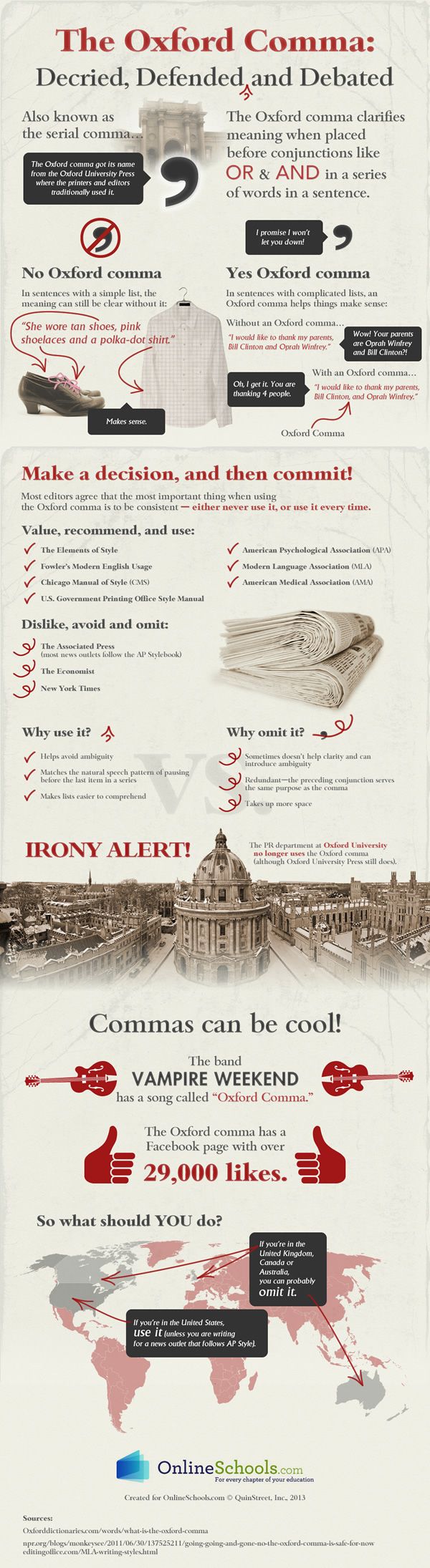
The Oxford Comma
I got a kick out of this. I am firmly on the affirmative with the Oxford Comma and I suppose we can still be friends if you wrong on this issue of vital importance. Enjoy a little gregarious grammatical guidance!

Tuesday, February 12, 2013
Exclamation of Joy
Ever wonder where the exclamation mark came from? Oh. Would you like to know anyway?
I found this interesting from the OUP word blog:
This is an excerpt from What Made the Crocodile Cry? by Susie Dent.
I found this interesting from the OUP word blog:
Both these punctuation marks [the ! and the ?] were originally manuscript abbreviations in Latin texts.
To take the exclamation mark first: it derives from a vertical version, written in the margins, of the Latin word Io, meaning ‘exclamation of joy’. The vertical stroke was the ‘I’ above the ‘o’, in which the ‘o’ eventually became a dot.
The question mark, meanwhile, goes back to the word Quaestio meaning ‘questioning, investigation’ and indicating a question. Quaestio was eventually abbreviated to a curly ‘q’ above the ‘o’, while the ‘o’ became a dot.
Why were these marks needed in the first place? Their prime function in Latin manuscripts was to show people the right intonation: a question, a surprise, a shout, etc. If you combine them you get a different effect: ?! delivers an immediate sense of incredulity: a little like smileys or emoticons in our text messages today.
This is an excerpt from What Made the Crocodile Cry? by Susie Dent.
Thursday, January 17, 2013
Gun Control and Apologetics
Conservatives are outraged at the hypocrisy of people in
heavily armed offices dictating that only gun-free zones will make you safe. We
can easily see how foolish it is to pass more laws to stop lawbreakers who
wouldn’t obey the first law. What does a gun free zone tell a criminal? It
tells the criminal that the law abiding citizen has laid down their best weapon
of defense.
Grace & Peace
Doug
When we engage unbelievers, being salt and light we are engaging in spiritual battle and they are wanting and expecting a
“Bible free zone” of apologetic in the public square. It goes something like “You
can’t argue from the Bible because I don’t believe the Bible, so we must debate
on common ground of what I consider to be good sound reason.” They want you to give up your starting point
but they get to keep theirs. You must abandon your worldview and engage their
worldview FROM their worldview. They borrow Christian terms like “right” and “wrong”
and “good” and “evil” that can only exist with a standard of right and wrong
and good and evil. And if there is standard, where did that come from and why?
Let’s imagine you are awakened from dreaming about living in a
free Republic to find you are being robbed. As a vigilant citizen you reach for
your Smith & Wesson and proceed to engage the lawless and disobedient. Full
of good courage, you play the man and catch the thief with his arms hugging your
television. When confronted with superior firepower he says with a furrow of anxiety upon the brow “I don’t
believe in the right of a man to defend his home with a gun. I think this ought
to be a gun free zone.” Would you reply “Oh, yes, certainly - allow me to
holster my gun, since you don’t believe in it, and we will get on common
ground.”
What has happened? You have conceded to his presuppositions.
You have laid down your weapon because he doesn't like you having it or doesn't want you to use it. He may genuinely not like it and not believe in it – but should
that stop you from using it? The believer
who attempts to argue apart from scripture has conceded that the unbeliever
somehow is coming from a neutral position. You believe in the authority of God’s
Word. He disagrees, but be sure he is not coming from an unbiased position.
If a person denies that the Bible is living and
powerful, does that make it not so? Is the Bible quick and powerful regardless
of what a person thinks about it? When we engage unbelievers who do not want to
concede that God’s Word is truth, don’t voluntarily turn in your Sword to the
proper authorities, who happen to have weapons of their own. I believe in
divinely inspired Word of God. This leads to the next reason - since the Bible
is divinely inspired, it is authoritative and I must bow the knee to God’s
Word. And, as if I planned it this way, leads to a thirdly - I believe the Bible
to be supernatural in power and sharper than any two-edged sword. That the Bible
gets down to the meat & bones of the matter and discerns your thoughts and
intentions. It is a powerful, spiritual weapon and our only weapon. Thus when engaging
in spiritual warfare, don’t turn the debate into a Bible free zone.
Wednesday, January 16, 2013
Fighting Today's Battles
J.C. Philpot battled a
great error that was gaining ground in his day - the denial of the
eternal sonship of Jesus Christ. In his introductory remarks he answered the objections
some had made to confronting that heresy in the first place. One group thought
the battle was not necessary because they did not understand the full
significance of the error. Some were persuaded by some “Big Guns” who had
decided for themselves (and for their followers) what the Bible said and that
settled the question once for all. A third group thought it was a fight over words
and why cause a fuss over semantics and the question should never been waged in
the first place.
When confronting error
there are usually these separate battles that the truth must confront. Not only
do you fight the error but sometimes you have to deal with those who should be
on your side but for some reason or the other decided to sit this one out.
Sitting it out wouldn’t be as bad, but often they cheer for the other team which stings a little.
Philpot said
“Those who from self-interest, love of carnal ease, entanglement in error, or cowardice of spirit, wished things to remain quiet as they were, all lift their voice against the disturbers of the general peace.”
Come on, ye who troubleth Israel, if you
were quiet, none of this would have happened (1Kings 18:17). It is amazing to see that the battles will change but the tactics and the positions of the enemies of truth rarely do.
Considering one of the great fights of
our day, which I believe is on Biblical marriage, we are starting to see
these groups appear. There are groups that don’t understand what the fuss is
all about. Others who think it’s better to live and let live. There are others
that wish it was like it used to be and among conservative Christians we are
most susceptible to the last excuse. Remembering the glory days when you didn’t have
to give a definition for marriage we can say that it should not be like this because it
did not used to be like this. Both are true statements, but unfortunately,
that line of argument is a useless defense of the truth because they say "so what?" and if we shrug and saunter away mumbling to ourselves away as to avoid the controversy because we did not get to pick the fight we lose the fight anyway.
Few who live in exciting times that we like to read about would choose the exciting time for
themselves. An old proverb went something
like “blessed are the forgotten nations of history.” Why? Who wants to read a
story about a country that lived in quiet peace for centuries.
There are fights in every
generation that rise. Sometimes the fight is greater than we think that we can stomach.
Sometimes it’s a fight we would rather not have at all. All who pick up the
sword of truth wish that it needn’t be so and it grieves us that God’s Word is
not obeyed. There shouldn’t be any that relish fighting – but that should not
stop the men of God. We can look at the spiritual battles for truth about us
and wish it were not so, wish for quieter times and peaceful seasons, but that is
not for us to decide. God has placed you in this time to fight the battle that
is going on now. It’s easy to be on the right side of a fight that is already
over-the test comes when the battles just starting to get hot. Your story has been written, it is not for you
to decide what times you live in – it is for you to decide how you will live.
Once more from Brother
Philpot:
“Old Mrs. Bigotry is dead and buried; her funeral sermon has been preached to a crowded congregation; and this is the inscription put, by general consent, upon her tombstone:For modes of faith let graceless bigots fight;He can’t be wrong whose life is in the right.
But if to contend earnestly for the faith once delivered to the saints is bigotry, let us be bigots still; and if it is a bad spirit to condemn error, then let us bear the reproach rather than call evil good and good evil, put darkness for light and light for darkness, bitter for sweet and sweet for bitter.”
Friday, January 11, 2013
A Love that Rejoices

"Paul wants [the Philippian church] to join him in cruciformity—to follow the One who laid down his life for the spiritual benefit of to others by likewise laying down their lives for the spiritual benefit of others. This is a love that rejoices in what is best for others... This kind of love will not result in selfish behavior that sinfully exploits others but produces “sincerity and blamelessness for the day of Christ” (Phil. 1:10). This kind of love will fill the Philippians “with the fruit of the righteousness that is through Jesus the messiah, for the glory and praise of God” (Phil. 1:11). God will be glorified when the Philippians live this way because mercy and love condemn selfishness and hate -salvation coming through discerning judgment for God’s glory." - James Hamilton, God's Glory in Salvation through Judgement.
This kind of Christian love wants the best for others for the glory of God.
Wednesday, January 9, 2013
False Humility is Pride
Pride is a
tricky sin. Sometimes we are most proud when we think we are most
humble. False humility is really pride.
Pro 16:2 All the ways of a man are
clean in his own eyes; but the LORD weigheth the spirits.
It is hard to find a guilty man when we make ourselves the judges of
right and wrong, and make ourselves the author of our own laws. We try and do
the work of Christ in our own life and try to justify ourselves. Christ is the Just
and the justifier (Romans 3:25-28).
However, there is a false humility that decries everything in our
souls that denies the truth of God’s work in our souls.
Richard Sibbes in his wonderful book The Bruised Reed was speaking to those ‘smoking
flax’ Christians, who are in continual despair over their salvation because they
see no fruit or deny or explain away the fruit that is evident in their life.
We must neither trust to false evidence, nor deny true; for so we should dishonor the work of God’s Spirit in us, and lose the help of that evidence which would cherish our love to Christ, and arm us against Satan’s discouragements. Some are as faulty in this way as if they had been hired by Satan, the ‘accuser of the brethren’ (Rev. 12:10), to plead for him in accusing themselves.
Don’t bear
false witness against yourself and don’t deny the work of the Spirit in your
life if you are in Christ. There will be evidences of the grace of God and it
is not humility to deny His work in sanctification. It is prideful to take
credit. It is prideful to look down at others. It is prideful to want to be
noticed and praised for the evidence of God’s grace. However, it is not prideful to see God’s
grace in your soul and to use what God has given you for His glory and thank Him for His goodness.
Bearded Gospel Man Joe Thorn in his excellent book Note to Self touches on this in his
section on pride.
Poor self-esteem in not an indication of humility or meekness. In fact, It may be a disregarding of the gifts God has given you and a mocking of the work he is doing in your life. How does this connect to pride? Haven’t you used this excuse of no ability and no talent to clear yourself of responsibility? Isn't it possible that you have used poor self-esteem as an excuse for doing nothing or as a means of saving face? Who could fault you when you don’t claim to be good at anything. Make no mistake about it – you are proud.
We must
remember what we are – creatures.
We must
remember who we are – children of God.
We must
remember where we are – in Christ Jesus.
Pride is a sneaky sin. There is no easy way to spot pride except to always be hunting it down
in our lives and be killing it-to spot him when he tries to sneak in the house. Sometimes Pride will knock on the door in a T-shirt
that says LIBERTY in some ultra hip font. Sometimes Pride comes dressed in his
Sunday’s Finest complete with a Full Windsor. Sometimes Pride saunters about like an extra from Downton Abbey. Sometimes Pride knocks on the door in
beggars’ clothes. We need to be careful when we open the door and be quick to show Pride to the door when he sneaks through the vestibule. We need to keep him "screwed to the sticking place".
The answer is to think much of Christ and the cross. To
remember what He did for us, what He does for us, what He is doing for us, and
what He as promised us.
Saturday, January 5, 2013
You and Your Sword
Paul W. Martin at Unashamed Workman has some good advise for the preacher specifically but for all Christians in general.
So preacher, if you are not already, then begin today to:
- Read your Bible.
- “Eat” your Bible (Jeremiah 15:16),
- study your Bible (Ezra 7:10),
- run your life by your Bible (Psalm 119:9-11)
- and do not add a thing to your Bible (Revelation 22:18).
Friday, January 4, 2013
Chapter and Verse
“You
are well aware, dear friends, that the division into chapters has only been
made for convenience’ sake, and is not a matter of inspired arrangement. I may
add that it has been clumsily made, and not with careful thoughtfulness, but as
roughly as if a woodman had taken an axe and chopped the book to pieces in a
hurry.”
Charles Spurgeon
Charles Spurgeon
Wednesday, December 26, 2012
Book Review: A Lie Never Justifiable by H.C. Trumbull
H.C. Trumbull was a prisoner of war during the Civil War and his captured cohorts devised a plan to escape that hinged on him lying to the guards. They put their confidence in the wrong man since he refused to go along with the plan because he said it is always wrong to lie. Needless to say, he was not the most popular man in the hoosegow and his cell mates failed at their attempts to persuade him that sometimes it is justifiable to lie, especially to Confederates and especially when lying would free you from said Confederates. Trumbull, at the time, felt it was wrong but wasn't settled that he had done the right thing, so he determined if and when he was released from prison, he would devote himself to coming to the conclusion of the matter.
The title gives away the ending. You know his conclusions going in but get to benefit from his search as he goes as deep into the subject as a person probably could and quite frankly, deeper than most people really want to go - down to if it is possible to lie to a fish if you are using artificial bait. There are all sorts of scenarios he goes over, i.e. is it a lie to leave lights on in your home to pretend you are home, is it a lie to throw a change-up, deceiving the batter (I think that is the illustration, but I could be mistaken - which, by the way, wouldn't be a lie would it?). There are several others, that gave me a chuckle, but I got the point when he asked if you can lie to your horse, and if you can, should you?
Trumbull gives some interesting anthropological information concerning tribes and peoples and religions all over the world, looking for a group that did not believe that lying is wrong. According to his research, he couldn't find a society that accepted lying in their morality. He also gives the Christian history of the argument and that this has been debated since the days of the early Christians, which I thought was very interesting.
His point is basically since God cannot lie, neither can you. He addressed the common objections such as Rahab (brother Proctor jogged my memory of the book) and the lying spirits in I Kings 22 and gives a sufficient answer, in my opinion. However, he does make distinctions by defining what actually constitutes a lie. For example, if you have no right to the information, I don't have the obligation to give it to you. If you are deceived by your lack of information, it is not my duty to make sure you are not deceived by telling all I know. If you are the goodman of the house, you don't have to make sure to reveal when you are going to be the most vulnerable to theft. So it is vital to tell the truth, but it is not vital nor wise to tell all the truth in all situations in a pearls before swine sort of way.
If you are interested in reading his position, there are reprint editions available or you can get it on you favorite e-reader for free.
Grace & Peace,
Doug
The title gives away the ending. You know his conclusions going in but get to benefit from his search as he goes as deep into the subject as a person probably could and quite frankly, deeper than most people really want to go - down to if it is possible to lie to a fish if you are using artificial bait. There are all sorts of scenarios he goes over, i.e. is it a lie to leave lights on in your home to pretend you are home, is it a lie to throw a change-up, deceiving the batter (I think that is the illustration, but I could be mistaken - which, by the way, wouldn't be a lie would it?). There are several others, that gave me a chuckle, but I got the point when he asked if you can lie to your horse, and if you can, should you?
Trumbull gives some interesting anthropological information concerning tribes and peoples and religions all over the world, looking for a group that did not believe that lying is wrong. According to his research, he couldn't find a society that accepted lying in their morality. He also gives the Christian history of the argument and that this has been debated since the days of the early Christians, which I thought was very interesting.
His point is basically since God cannot lie, neither can you. He addressed the common objections such as Rahab (brother Proctor jogged my memory of the book) and the lying spirits in I Kings 22 and gives a sufficient answer, in my opinion. However, he does make distinctions by defining what actually constitutes a lie. For example, if you have no right to the information, I don't have the obligation to give it to you. If you are deceived by your lack of information, it is not my duty to make sure you are not deceived by telling all I know. If you are the goodman of the house, you don't have to make sure to reveal when you are going to be the most vulnerable to theft. So it is vital to tell the truth, but it is not vital nor wise to tell all the truth in all situations in a pearls before swine sort of way.
If you are interested in reading his position, there are reprint editions available or you can get it on you favorite e-reader for free.
Grace & Peace,
Doug
Saturday, December 8, 2012
Please Stand By
Hello dear readers. The blog has been a little slow. Full report to come.

Grace & Peace.

Grace & Peace.
Saturday, November 17, 2012
Miscellany
I have a whole
list of random things I was going to write about, but never finished. So I'll
give you a bit of weekend randomness, miscellaneous materials, indiscriminate items,
unsystematic observations – stuff. Enjoy.
Item 1
Tolkien
didn't want The Hobbit published
in Nazi Germany: Though he was popular in
Germany for his academic writing on old Germanic and Norse cultures, Tolkien
was disgusted by Nazi Germany, and called Adolf Hitler a "ruddy little
ignoramus." When it came time for a German edition of The Hobbit,
a German official asked Tolkien to prove that he was "Aryan" enough,
in accordance with Nazi law. Tolkien instead wrote a
letter back expressing regret that he didn't have Jewish ancestors. (Link embedded to original article).
Item 2
This summer we went to the place where General Stonewall Jackson died. He was shot by his own men, and killed by his own doctors (not purposefully mind you, but does that really make it any better?). They spent all efforts to save him, but what was "good medical treatment" at the time actually killed him. Had he not been on the receiving end of the priority treatment, he would have probably survived.


This is the bed that General Jackson died in. The blanket at the foot of the bed also was the same blanket that covered him.
The clock on the wall also was original to the room. The daughter of the home was 11 years old when Stonewall died. She kept the bed, the blanket, and the clock for 70 years. She donated them to the National Park services, and came into the home and arranged the furniture exactly how she remembered it when Stonewall passed away.
Item 3
The King James Bible shaped our language. You won't say that about modern translations.
Tuesday, November 13, 2012
Winking and Prating
Proverbs 10:10 He that winketh with the eye causeth sorrow: but a prating fool shall fall.
I hope that you aren't winking and prating about because that would indeed grieve the heart. You may ask "how do I know that is it bad to be prating and winking?" We know this from the result of each - sorrow and falling. So we know from the start that this is not a good thing. Since we know it is bad, let's figure out what it is that is bad.
Winking with the eye in the Bible is always shown as a devious act (Pro. 6:13; Job 15:12; Psa.35:19). Really no different than it is today.
Prating is babbling, and the fool who babbles speaks his heart. So a prating fool goes on and on, with each word revealing to every unfortunate soul in earshot that he is indeed a fool.
In this proverb, as in most, we have two different people, with two different outcomes. The word "but" separates the the two situations. Often "but" will transition from good to bad. For example, if you would scan up to the previous verse, we conveniently have an example in Proverbs 10:9. He that walketh uprightly walketh surely: but he that perverteth his ways shall be known. Here we see that the upright walk sure footed *but* the man that perverts the way shall be known. You have the godly and ungodly compared and contrasted showing you one way is superior to the other.
Our proverb is different though, because both ways are bad and both outcomes are bad.
A) He that winketh with the eye causeth sorrow:
but
B) a prating fool shall fall.
So the "but" in verse 10 doesn't transition from bad to worse, but we know that this conjunction does transition us some way, so what are we contrasting? Both A and B are people you do not want to be and both end results are places you do not want to go. Now we need to think about what the difference is in order to gain wisdom.
The difference is in the person that is hurt. The "winker" of line A hurts other people. He causes sorrow. The prating fool of line B hurts himself. The fool who rambles on in his foolishness can and often does hurt other people (read the whole of chapter ten with the theme of work and words in mind and you can see the result of the words of a fool). Though he may not necessarily hurt others, he will hurt himself. He is going to fall.
I believe that this proverb is a warning for those with a foolish mouth. The liar and the deceiver the backbiter and the thief is universally known to hurt other people. We all know the kind of person that is being described and we've all experienced the pain of a wrecking ball of deception Perhaps, such were some of you. But the foolish talker doesn't realize the pain he causes because he hurts himself, and nobody wants to hurt themselves, for no man ever yet hated his own flesh. If the foolish talker knew he was a) a foolish talker and b) was hurting himself, he would surely probably stop.
Here is the important part. We have to press on. We can't stop here, or we just learned a proverb. We have to look in the mirror and examine our own words. Am I a foolish babbler? What do I talk about? Does my mouth have a break and if so does it work and do I know where it located? Is there a filter between head and mouth and if so, is it working?
Think about it this way. In you minds eye, the part of "he that winketh with the eye" will be played by a car thief The prating fool will be portrayed by a person who never checks their oil in their car. The car thief will cause sorrow to others. But the person who never checks or changes the oil in their car only brings hurt on themselves. They hop in the car, cruising with the windows down, without a care in the world. "Those windshield wipers slappin out a tempo, keepin perfect rhythm with the song on the radio, gotta keep rolling" says Mr. Rabbit and all is right in the world. But the fun and games come to a stop when the engine does. The whole car was groaning under the foolishness of the car owner, who was oblivious to the harm their foolish behavior was causing and the pattern of foolish behavior brought the bad fruit. There is another option, which I think hits the mark for most people. The fool knew they were doing wrong and just didn't care or didn't believe the warning was true.
The prating fool will fall.
Doug
Doug
Subscribe to:
Posts (Atom)