Showing posts with label Books. Show all posts

Tuesday, May 29, 2018

New Testament Commentaries - Study Tools


Today we will look at a few New Testament collections. 


Expository Thoughts on the Gospels
I wish more men would write like J.C. Ryle. He wrote like a man. He wrote like himself and to be understood. He is so clear and I never leave off reading wondering what he believed. Lots of pithy insights and a favorite of mine.

John MacArthur New Testament Commentary
These commentaries cover the whole of the New Testament. The individual volumes are not broken up by chapters of the Bible, but each chapter of the commentary is broken up into the preaching sections, or sections of thought. Each chapter covers a portion of the text, just as he preached in his church, so they do read like an expository sermon series. I also like it because he draws a lot from other sources, gleaning their best thoughts. If you are short on time, you can often read in his commentary what many other men thought in theirs.

Faults? Being it’s sermon-like, some of the more difficult passages you actually need help with, are somewhat thin and parts that need little explanation are dealt with for pages. Also, each chapter gets a sermon introduction, which often is not helpful for a commentary.

*(Note: The Galatians and Hebrews commentary contain the error that Jesus became the Son at his incarnation, and denies the eternal sonship of Christ. Though he eventually came to the truth, it was not before these volumes were written. It may have been updated in latter editions, but my editions contain the error). 

Robertson's Word Pictures of the New Testament
A. Robertson focuses on the Greek text of the New Testament. Very helpful when it comes to the moods and tenses of the Greek language. He wrote for people who know little or no Greek at all. More of a word study on key words rather than a commentary, but the commentary you do find is very good.

The Word Studies in the New Testament by Marvin R. Vincent

Robertson quotes Vincent often, and will sometimes argue with him in his work, but more often he agrees or expounds. I read them both together. I never understood people who say that you have to the Greek because you can trust a single translation team, but then only reference one Greek Lexicon, written by one man. If a team of Greek Scholars can't be trusted to translate, why can one Greek scholar be trusted to give you the right meaning?

  • Wiersbe's Expository Outlines are pretty good for an overview of things. 
  • Robertson's Harmony of the Gospels is very helpful. 
  • Trapp's Commentary on the New Testament is hit and miss, and the comments far to brief to be much help on the meaning of the passage, but some good thoughts for application.  

* Updated 5/29/2017


Saturday, May 19, 2018

The Concordance - Study Tools

I was going to add concordances to the list, but I’m not sure that is even necessary anymore. I have a Strong’s concordance on my phone. And I can find what I was looking for through computer software before I could get out of my chair and get the Strong’s off the shelf. This tool was, even when I started preaching, an indispensable tool for Bible study. I still, every once in a while, will take the book and a pen and paper and do study away from all technology. Brother Strong certainly served his generation well. It is especially important for a man to read the preface to the concordance. Isn't it amazing how much weight and confidence we have in this one book, and yet not take the time to read the introduction of the author and his purpose for the book and how he intended it to be read and used?

I remember buying my Strong’s Concordance in Ashland, Kentucky in 1998. A new bookstore just opened on Winchester Street and I wanted to check it out. Like most Christian “book” stores, the shops in the area were about 4% books and 96% trinkets and of the poor books on sale, most of them were not worth the paper they were printed on. When I entered the shop, most of the books were still in boxes and few had even been arranged on the shelves. But the books that were out and ready for purchase, providentially, were the good ones.  I was about to make my first Bible book purchase. Until this point, the only other book I had about the Bible was one that I got at the Calvary Baptist church bookstore. It was Sermons on Catholicism by John R. Gilpin. I remember asking for that book a few times before Mom finally bought it for me. I really don’t know why a 10 year old boy was so interested in that book, but I was and bought it and read what I could, but didn’t really understand a lot of it. Eight years later, I’m about to lay down my own money on some study tools. I saw a box of Matthew Henry’s on sale and grabbed those. Close by, maybe on the same shelf, I spied the Strong’s Concordance. I knew this book was important because I remember my Dad, laying in the living room floor with his Bible,  his brown covered Strong’s and a notebook many an evening. There were several editions. Strong’s, the New Strong’s, and the Strongest Strong’s. I didn’t know the difference and figured I should stick with the original, which remains my policy to this day, unless there is a good reason to get the updated or edited version of an author who is dead and gone. I still don’t know what the difference is and don’t care enough to find out.

Friday, May 4, 2018

My Bible - Study Tools

I suppose I should have started with the Bible in my recommended books, but I assume you already have and regularly read a Bible. Concerning the printing and making of study Bibles," there is no end" and they continue on day and night forever. I'm no fan of the specialty Bibles. The hunter’s study Bible. The NASCAR study Bible. The Gaither Homecoming Study Bible. The Duck Commander Study Bible. The Teen Bible, but not to be out done by the Extreme Teen Bible. If you are reading God's Word, praise the Lord. I wouldn't want to discourage that, but you have to remember that Bible publishing is a business -- supply and demand. I hate to say it and to think about it, but it’s a fact. Publishers find out what the people want and give it to them, at affordable prices. Bible publishers have marketers who want you to buy their product. My advice is to stay away from these affinity Bibles altogether. Nothing wrong with having a hobby, but a Bible designed around your hobby, age, gender, or preferences and put you at the center of the Bible's message. My purpose is not a translation discussion, but my recommendation is the Kings James Bible.

I can only tell you about the Bible's I have used, so I'll tell you the story of how I came to use the Bible I have now. When I announced my call to preach, the Beauty Ridge Missionary Baptist Church bought me a Nelson’s Open Bible. I loved the study tools, especially the subject index, which was such a useful tool for someone who was, as Spurgeon said, a man of "slender apparatus". The only thing I didn’t like about it were the illustrations. I found them distracting and pointless. When my pages were starting to fall out and the bonded leather was coming unglued and I needed to upgrade, I decided to find a Bible without the illustrations in the middle of the text.

I bought a Scofield Study Bible. Why? Because a preacher I admired preached from one, and if it was good enough for him, it was good enough for me. I didn’t find the notes particularly helpful, especially on creation and the Sermon on the Mount, but I loved the type set and the paper. I bought the wide margin version and as I taught Sunday School, I wrote all my notes and outlines in the margins. I had gone through a couple books, Job, Acts, and Galatians and had filled the margins with notes, references, definitions. I loved it. I would make my own study Bible. One Sunday, I preached for a church without a pastor. They told me they had a morning service, ate, then had an afternoon service. I went and preached, we ate, and then I waited for the next service to start. One of the men asked me if I could leave so they could start their business meeting. They had a service, but with no preaching, so while I waited for the service to start, they were waiting for me to leave. I was a little aggravated because at the time, my oldest was about 3 years old and we had an infant, and they were a handful after lunch, especially after sitting in church all morning, followed by a fellowship meal. I could have left 45 minutes sooner, if they had told me. We had a few hours to drive to get back and I just wanted to get back. The boys were screaming and crying, not wanting to get in the car seat, I set my Bible on top of the car while I buckled them in the car. I was supposed to preach that evening at my home church. We arrived safe and sound, about 30 minutes before the evening service. Getting everyone out of car seats and ready to go in the building, I can't’ find my Bible. I remembered setting the Bible on top of the car, but not putting it back in the car. I got a sick feeling in my stomach. After emptying the vehicle of its contents and no Bible was discovered, it confirmed my fear – I left it on top of the car and drove off. That was the last I ever saw of that Bible.

My mom bought me a replacement, another Scofield. It wasn’t a wide-margin, those were now out of print, but honestly, the thought of putting my notes in another Bible broke the Newell heart, to be sure. This Bible was also bonded leather. I sent it off to Mississippi to be rebound and had blank pages inserted in between each page. It is heavy and think, but still very nice. My problem? I couldn’t see it from the pulpit. I wasn’t sure why, since it had the same size font. I had my eyes checked out, and received a good report. During this time, I started working for Oxford University Press, who published the Scofield Bible. I discovered the wide-margin I lost was made with India paper, which is thicker and has less ghosting because of the superior quality. The wide margin I lost was one of the last runs of this higher quality Oxford Bible. The newer Scofield Bibles are manufactured in Korea with a much thinner, cheaper paper, which explains why when you underline, you can see the ink on the other side. Cheaper Bibles, cheaper quality paper. At first, I thought it was the print size, so I got a large print when I worked for OUP, and I had the same problem. I learned a lot about the Bible business, publishing, and the nuts and bolts of mass producing Bibles while I worked with the Bible department.

Having learned more about paper quality, bindings, and fount from OUP, I  tried the Cambridge Wide-Margin with the higher quality, thicker paper and bolder font. My wife bought me the Cambridge as a gift right before I went and preached a revival meeting. One of the first times I preached from the Bible,  I said, “Turn to Revelation 21” and I tried to do the same, but my Bible ended with Revelation 19, which I felt was a little disappointing and set the tone for the experience I had with it.  Their customer service was a delight. The quickly replaced the Bible, but the replacemnt had ink smeared on several pages. So they upgraded me to goatskin leather version, which was great. Quite a big jump from bonded leather, or even genuine leather. The ink was faded in some places on this Bible. I could read it, but it looked like a printed page when your printer is running out of ink. I gave up and kept the Bible.

I still had a hard time reading from the pulpit, and now just reading. Plus, the Bible is large, and most pulpits were not designed for Bibles and notes. That’s when I found the R.L. Allan & Son Publishers, King James Bible. They sale high quality Bibles. Up front, they are rather expensive but they are very nice and I think they are worth the money. Mine is printed on India paper and bound in highland goatskin leather, which is very soft and makes for easy turning and comfortable reading. The font is 8/9, but the paper is high quality and thick so there is very little bleed through. They also use bold font, which I have discovered is the second component to easy reading in a Bible. It is better to have thicker paper and bolder font than to have bigger font on thinner paper. I love it and highly recommend getting one, especially if you are having eye problems. That’s what I have now, and wouldn't think about using any other now. I like everything about it.

Get a good Bible and read it. Buy one, read that one Bible and get familiar with that Bible.


Monday, October 26, 2015

The Boys in the Boat by Daniel James Brown

Image result for boys in the boatI didn’t know the first thing about competitive rowing. I never have rowed and never will. But that didn’t stop me from loving this book. I heard Alistair Begg mention the book in a sermon and I spotted it at a library sale for $1 – so I took a chance and am glad I did. In fact, my heart was racing with the thrill of the race when reading about Joe Rantz and the University of Washington crew as they overcame seemingly insurmountable odds. I teared up reading of their physical, personal, and emotional trials. As I was reading one section on my lunch break, I sat the book down because I anticipated what was about to happen and couldn’t bear to read on if what I thought was about to happen did. A few minutes later I picked it back up, and sure enough, another tragedy.

This was a really well told story. Daniel James Brown gratifyingly weaves the story of these men and their struggles with the struggle that the United States faced in the great depression, and with the struggle the world was about to face with Nazi Germany. He also did great job describing the ins and outs of the sport of rowing for the novice, like me, who comes to the book having only rowed a joh boat and canoe looking for bluegill. The art and skill of the master craftsmen, George Pocock as he meticulously crafted the best racing shells in the world was fascinating to me.  


This was good book and a wonderful story about an amazing time in history.

Friday, September 11, 2015

The Road to Character by David Brook - BookReview

This way a very interesting book. I love the premise and agree with much of it. We both want to live in the same society but where I disagree with the book is how to get there. I like that he hopes to get the questions and discussions of virtue and character back into the public square. He does this by defining his terms and then uses biographical sketches in each chapter to flesh his thesis out and then wraps it up nicely in the final chapter.

Our contemporary culture is concerned about, as Brooks puts it, "resume virtues" and really ignores what he calls "eulogy virtues". Resume virtues being college degree, financial achievement, etc. But no one will talk about your masters degree at your funeral. At a eulogy, people talk of honesty, courage, wisdom, etc. He proposes that we have neglected moral character and have devoted ourselves to outward, fleeting success.

He is right and did a great job of not only identifying the problem but also showing how that problem came to pass. This, to me was outstanding portion of the book.  Brooks identifies that man is fallen and broken by sin (yes, he says it is sin and makes the case that our country is far worse off for having "lost" this word) and that if we go within to find our standard of morality and goodness, we make gods of ourselves. He quoted G. K. Chesterton, who once observed that the reality of sin can be seen on a lovely Sunday afternoon when bored and restless children start torturing the cat. Brooks says:
"If you believe that the ultimate oracle is the True Self inside, then of course you become emotivist—you make moral judgments on the basis of the feelings that burble up. Of course you become a relativist. One True Self has no basis to judge or argue with another True Self. Of course you become an individualist, since the ultimate arbiter is the authentic self within and not any community standard or external horizon of significance without. Of course you lose contact with the moral vocabulary that is needed to think about these questions. Of course the inner life becomes more level—instead of inspiring peaks and despairing abysses, ethical decision making is just gentle rolling foothills, nothing to get too hepped up about."
 We focus so much on ourselves, anything that causes pain or uncomfortablness in our lives must be bad. Where, it is in the struggle where we are refined. We have become uncomfortable to face the reality of our own souls. He said "we are to morality what the Victorians were to sex." Which is a great line. Our prudishness in 2015 is directed towards virtue and morality.

But, (this is a book review, so there has to be a but) I think that his rules for character and his humility code do not really miss the boat, but more aptly in the book we get on the wrong boat. Brooks illustrates character by walking us through short biographies of men and women from different walks of life. He uses religious, non-religious alike to show that there are different ways to character. While true, there are different ways to reform the outside of the cup, there is only one way to clean the inside and that is the blood of Christ.  This is why I believe the chapter on Augustine to be one of the best of the book. He pulls no punches here, talking of grace and redemption. Sin and humility. Perhaps by design? I don't know.

There are parts of the book that make me want to buy copies and give them to graduating seniors...and then there are parts where I don't know if I would even recommend it. It is a strange book. Partly because he talks of moral issues that are not tethered to anything. I suppose that is it - virtue and character building must be tethered to something greater, and just saying "something" isn't enough to motivate and move people to action.  I hope some lost soul does not buy the book and get pulled into the legalistic, stoicism that is talked about, but is broken by their inability to do what is necessary and finds the One who lived a perfect life for us and gives us the grace to follow Him. I was thankful that as I realized I will never be as great as the people in the book, that in Christ, I have my identity and my life and my soul are tethered to Him. I have been given His righteousness and stand complete in Him.

Friday, July 17, 2015

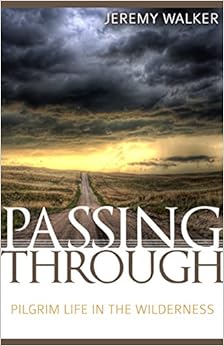
Book Review - Passing Through: Pilgrim Life in the Wilderness by Jeremy Walker

Are you a Pilgrim? If you are a Christian, the answer is yes, you are. Maybe the idea brings to the American mind thoughts of the Mayflower, Thanksgiving, and funny hatted people discovering a new world. Or, perhaps the idea of a person making their way to some far off shrine as the grand object of their worship. Does the idea of a pilgrim put you in mind of a ordinary man or woman, the mechanic, or homeschooling mother? How about a 16 year old high school student trying to decided which college to attend? Perhaps not because, as Jeremy Walker points out in his newest book Passing Through: Pligrim life in the Wilderness, Christians don't think often enough as our identity as travelers. This book is a good corrective to what may be lacking in our times. 
 
We, in the West, have enjoyed the fruits of gospel revival of the past centuries, living in a culture that was shaped by Christian men and women. That advantage is either dead or dying and we are finding ourselves in the precarious position of learning to living like our forefathers lived. We are, as the subtitle suggests, just passing through; travelers on a journey home. This book addresses the reality that this world is not our home - we are on a pilgrimage. We are in this world, but not of this world.

The opening chapters make sure we understand what it means to be a pilgrim and that we stay on the path and don't fall into the ditch of isolationism or the ditch of worldliness. To avoid being worldly, we are tempted to hide in the bunker and separate from everyone and everything. But the opposite extreme is to take in as much as the world as possible, disregarding our Lord's command for holiness. But the true path of the is neither isolationism nor is it worldliness. Not taking for granted that we even understand what the "world" is, Walker helpfully defines his terms, making sure that we are all on the same page before moving on to the next point.

From there, the focus turns to understanding the world in which we really live in and our role in that world as kingdom people. Loving the world means loving that which is hostile to our Lord and our task as pilgrims is to be faithful and keep our eyes on Christ and we navigate through this journey. We are ambassadors, living in hostile territory and our message of peace and the terms of peace are enmity to the human heart. This book helps us to get our mind around this reality and to understand the world in which we are passing through.

This book is readable, but it is not light. Each chapter follows the pattern of the subject being defined and illustrated, then a spiritual framework is given, followed up by summary thoughts, so each chapter's subject is thoroughly deal with. Full of pastoral application I believe Christians who are unfamiliar with the idea of pilgrim life or Christians who are not struggling with the thoughts of living in an hostile, anti-Christian society, will be helped and encouraged.

 Christians have a King, we have a citizenship in Heaven, and we have a mission and this book helps us to get our bearings, who we are, where we are, were we are going, and what we have to do. 

You can listen to an interview on the book both HERE and another one HERE.

You can buy the book HERE (among many other places).

My thanks to Cross Focused Reviews for the review copy. 


Tuesday, March 3, 2015

Book Review - God’s Battle Plan for the Mind

God’s Battle Plan for the Mind:
The Puritan Practice of Biblical Meditation
 by David W. Saxton
Reformation Heritage Books

The Puritan authors were big on the practice of  Biblical meditation and David Saxton has provided a well ordered view of their thoughts on this spiritual discipline in his book God's Battle Plan for the Mind. Far from being a new age mysticism that empties the mind, Biblical meditation is a filling and directing the mind to pondering God's Word. Teeming with quotations from the old masters, Saxton gives us the Puritan's thoughts on guiding their people through this necessary discipline in the Christian life.

After providing the reason why we should meditate on the scriptures, Saxton defines the practice and shows us how to meditate on the Word of God, and then warns us against some common hindrances to the practice.  It is one thing to say "you need to meditate" and move on, but Saxton points out that the Puritans didn't leave it at the command, but also gave practical advice on how to practice mediation and exhorted their people to the good and godly work. Meditation is not the same as a daily reading program, nor is it a study on an unknown or unfamiliar topic, but a concentrated time devoted to thinking upon known Biblical truths and how these truths are to be applied to Christian walk. The section on topics for meditation and why the familiar doctrines are those that are best suited for mediation will prove, I believe, to be a helpful guide.

Saxton's style works well in a book that where quotations necessarily abound. His writing smoothly transitions from the Puritan quotations to his own observations. Using the KJV, there is a good flow stylistically throughout; quoting authors covering a 400 year period is a difficult task to carry out, but he did a good job making this book very accessible for the modern reader. In fact, books like these show how readable and delightful the Puritan works can be.

Interestingly, meditation on the scripture is not a problem that is isolated in smart phone societies. The Puritans bemoaned the fact that a lack of mediation was a serious problem in their day as well. I found the advice addressing this problem both stirring and practical. Exhorting their readers 300 years ago on how to keep their mind focused upon God during their busy workday is as relevant today as it was then. It is easy to blame our problems on our technology and think that if we could only go back to simpler times, we would be more spiritual, but sadly, it just is not the case. Our sin nature is the problem, not our apps.

Overall, this is a very good summary of what the Puritan teachers described and urged in the practice of Biblical meditation and an excellent resource for those who do not currently practice Scriptural meditation and excellent motivation to spur you on if you are already in the habit. Far from being a rigid and uptight practice, this book shows us that meditation is a way to increase our love for Jesus and not only benefits our soul, but becomes a lovely duty as we worship our our great God, with our hearts and minds.

My thanks to Cross Focused Media for the review copy.

Tuesday, January 27, 2015

Review of Discovering God's Will by Sinclair Ferguson


This book is a gem. Yogi Berra once quipped, "If you come to a fork in the road, take it." I think that some Christians view their decision making processes much in the same way. They make the choice and then think about their decision making process latter when the consequences come. What is a Christian to do when we come to a fork in the road of our life and multiple choices seem to be before us? Which way do we go? What path to we choose? Many people, when they want guidance just want someone to tell them exactly what to do. They want a sign, they want specific directions.

Sinclair Ferguson deals with the issue of guidance Biblically and gives the reader the foundation and principles needed to make wise decisions. The foundation of knowing what to do is God's Word. Will the Bible tell you which girl to marry? No, but it will tell you what you should be looking for in a wife. God wants us to think and that is not an unnatural exercise. This is the kind of book that I think should be required reading for young Christians. This would be a great tool for Christian teenagers to read and digest while still at home prior to making many choices that will set the course for the rest of their lives. It is better to know and have the principles before a big decision has to be made.

What I appreciate is the fact that the book is founded on the principles of the sufficiency of scripture, but does not deny the spiritual aspects of the Word. This book may be extremely helpful for those who tend to bend towards the Charismatic side in their idea of what the will of God is and what guidance actually entails. 

Good book.

Thursday, October 2, 2014

Book Review: A Rulebook for Arguments

I love good books and I have a recommendation for you: A Rulebook for Arguments by Anthony Weston.  
 
In fact, I think you should read it and refer to it often. You may say, “but I don’t get into arguments”. If you said that, then you definitely should read this book. This isn’t about fighting, this is about communication. This is about persuasion, and about recognizing errors in logic when people are trying to persuade you. The book gives you a very basic overview of logic and argumentation, a great introduction to a wider and deeper world. If you are at all interested in apologetics, this would be a nice book to grab. Coming in at only 90 pages, you are not going to be overwhelmed. I regularly refer back to it to to check myself and others.

If I were the king of the internet, I would make it a requirement to read this book before posting a comment. Once upon a time, when I and the internet were still young, I spoke harshly and committed many a logical fallacy in many a comment sections. After reading this book, a soliloquy ensued. “If only I could have known!” as I rested a regretful head on keyboard calloused hands. Rising from my office chair in resolute determination I said “If others knew that the clever comebacks and quips they so often hear from the pulpit and news sites are logical fallacies and are not helping the cause but in the long run, hurting the cause, they can avoid the mistakes I have made!”

In all seriousness, this is a really good book to at least get you familiar with the concepts of logic and to recognize when you are not thinking clearly about a topic. It might ruin cable news for you, since political talk is a lesson in fallacy, but I’ll chalk that up as another reason to go and get this book. This is NOT a Christian book, written from a Christian perspective, so you’ll need to be discerning. However, all truth is God’s truth and logic helps you to see, hear, understand truth, and defend truth. If we are going to defend truth, we need to defend the truth in a truthful way.  I’m not the only one.   If nothing else, you'll learn some cool Latin phrases. 


Saturday, June 21, 2014

Quiet: A Book Review


Quiet: The Power of Introverts in a World That Can't Stop Talking

by Susan Cain


A very interesting book on the idea of a quiet personality. Whether or not the categories of introvert/extrovert are correct, I don’t know, but I do know I found myself relating to and identifying myself in the descriptions of the introvert. Some of the studies fascinating to me, especially how the brain and the chemicals in our bodies react differently in different people in the same situation. Though I can’t speak for the validity of the research, I can identify with most of the characteristics of the introvert that were listed and believe I have benefited from some of the practical suggestions that were given.

But I had two problems. The first is that there is no place for the soul in the book. It is all about the body and our physiology. Tenderheartedness is a fruit of the Holy Spirit of God. And though, by God’s common grace, there may be some that are more sensitive than others – this is not a chemical, evolutionary attribute but because we are made in God’s image, some are more tenderhearted than others. But, the extroverted believer, indwelt by the Spirit, walking in the Spirit, will also be tenderhearted. The reverse is true – sin isn’t excused by “I was born this way” which was subtly hinted out in a few places. 

The other issue (since I said I had two) is Cain really didn’t have anywhere to hang her introverted hat. Meaning there were was nothing solid to hang her assertions on and no solid ground for  her exhortations. A Biblical view would be that God has created us, knit us together in our mother’s womb to be the person that we are. I am what I am by the grace of God. There are places that my quiet personality can be used for God’s glory, and there are places that the outgoing will be used for God’s glory.

If we take the introvert/extrovert personality types for granted as correct categories, then we should realize that each person is a depraved introvert/extrovert, and will be selfish with what God has blessed them with. The extrovert will, at times, selfishly make himself the center of attention and bull over the quiet and the quiet will, at times, selfishly keep and withhold good from his neighbor. Those who are quiet and thoughtful will not express concern, warnings, and show love while those who are extroverted may take and take without being quiet, listen, and receive. All through the book, I my mind kept coming back to the book of proverbs and thinking "the answer is here! This is a spiritual issue!"

I learned a lot from the book, both when I agreed and disagreed. I don’t know that I would recommend the book, but I would urge you to do a thorough study of the mind, soul, and personality from scripture before picking up this book.

Strike that. Whether or not you read the book, do the study anyway. 

Grace & Peace

Tuesday, April 29, 2014

Book Review: Great Kings of the Bible by Deepak Reju

Great Kings of the Bible: How Jesus is greater than Saul, David and Solomon
What a nice book. It follows the lives of Saul, David, and Solomon and points out their strengths but really pointed out their failures as both men and kings. The great part of the book is that it uses this opportunity to explicitly point to Jesus Christ. David failed, but Jesus never did. It points us to the true King of Kings.

The illustrations were wonderful and very lifelike. I appreciated that there were no pictures of Jesus in the book, instead pictures of scenes from the gospels (the stormy sea, the empty tomb). I put the book to the test after I read it; I took it to my Sunday School class (ages 7-10). The verdict? They loved it. When I was finished they asked if I could read it again next week for our lesson. It opened up some very interesting discussions.

I don’t own many children’s books because good books like this are few and far between. Finding a book that is theologically sound and that doesn’t turn the men and women in the Bible into cartoon characters is difficult. This book is sound in both areas. No false gospel, and a true representation of the people in the story. By telling the Bible account,  you see the men, warts and all. That being said, the only concern I would point you to is the account of David and Bathsheba. It is faithful to the text, so keep that in mind for younger children.

Thanks to Cross Focused Media for the review copy

Thursday, April 24, 2014

Book Review: Gospel Assurance & Warnings by Paul Washer

Gospel Assurance & Warnings
by Paul Washer

Paul Washer's new book Gospel Assurance & Warnings is the third book in his Rediscovering the Gospel trilogy. These books are written to rightly set forth the truth of the gospel of Christ. This book, as the title aptly informs, is broken up into two sections; assurance and warnings. The assurance section walks the believer through key texts in the book of I John on how we can know that we have been truly born again. By examining the qualities John lists as signs of the new birth, we are encouraged that these are evidences of saving faith. Washer does a very good job in explaining these important truths in a simple, yet straight forward way. Even when coming to difficult or often misunderstood passages, the clear meaning of the scripture is declared then applied. 

The last portion of the book deals with the great error of easy believism and the sinners prayer, and the false professions they encourage and create and is centered on sections of the Sermon on the Mount. It is a terribly dreadful proposition to consider that many church members do not know what it is to be born again and many preachers are assuring these false converts giving hope where there is no hope. Because of the sinners prayer (bad theology put into practice) countless have been deceived by pastors and evangelists that they have been saved because they repeated a prayer when the Bible gives a very different gospel and description to what it is to have saving faith. This book points out the error then gives the evidences of saving faith.

Washer’s writing style is impassioned, clear, and steeped with Biblical passages and imagery which is a refreshing change from other popular authors who like to mince words. The way in which Washer simultaneously asserts Biblical truth while denouncing false preachers and theology put me in mind somewhat of writing of A.W. Pink.

This book would be very helpful for one who is having doubts about their salvation or a new convert learning about what it truly means to be born again. The exhortations, warnings, and clear Biblical instructions found in this book are to be commended.

My thanks to Cross Focused Reviews for providing me a copy.

Tuesday, February 18, 2014

Book Review: Spiritual Warfare: A Biblical and Balanced Perspective

Spiritual Warfare: A Biblical and Balanced Perspective is an excellent overview of spiritual warfare. Using Ephesians 6:10-20 as the structure and the outline of the book, authors Brian Borgman and Rob Ventura expound what Paul tells us both about the spiritual war Christians engage in, and the weapons of that war.
The “Biblical Perspective” in the subtitle comes from the exposition of the text. The authors do a good job of giving the historical background of the book of Ephesians, and then chapter by chapter lays out what the text says before applying the text to the Christian life. However, the book doesn’t read like a commentary or someone’s sermon outlines, it is both instructive and readable.

The “Balanced Perspective” in the subtitle alludes to the interpretation and view of the spiritual warfare. In the introduction, C.S. Lewis is quoted from The Screwtape Letters “There are two equal and opposite errors into which our race can fall about the devils. One is to disbelieve in their existence. The other is to believe, and to feel an excessive and unhealthy interest in them. They themselves are equally pleased by both errors and hail a materialist or a magician with the same delight.”  This book affirms the reality of our enemy and the spiritual struggles from both without and within on our Christian pilgrimage; however, the focus is not on the forces of evil, but on Christ which is the key to this book.

Spiritual Warfare is well written and engaging. The chapters are short and quick to the point, but also full of spiritual instruction. Each chapter concludes with questions for reflection and discussion, which makes this book valuable for study groups, family worship, or other small groups. The latter portion of the book is especially beneficial to preachers and pastors on the chapters on prayer, the Sword of the Spirit, and the proclamation of the Word of God.  I would recommend this book as a good place to start on spiritual warfare, or for a pastor studying Ephesians. My thanks to Cross Focused Media for providing me the review copy.


Friday, January 24, 2014

Book Review: Life in Christ by Jeremy Walker

What does it mean to be a Christian? In his new book Life in Christ, Jeremy Walker walks us through what
the Bibles tells us about the most important of all subjects; salvation and union with Christ. Jeremy puts on display many areas of Christian life and experience, drawing out the realities of the new birth, implications of saving faith, blessings of union with Christ, and changes God works in the believer as a new creature in Christ.

Starting with the gospel and saving faith, we are guided through what it means to have been saved, to be saved, and to look ahead to the glories that await those who are in Christ. He begins by explaining the gospel- that Jesus is the object of our faith, to whom we look. Then, as a born again child of God, the life we have, our identity, our hope, our righteousness is in Christ. Jeremy points out that when we begin to think of what it entails to be “in Christ” we see that this is not a superficial decision one makes, but Christ is the unsearchable, fathomless, and glorious treasure whose depths we will spend an eternity exploring. Salvation is bringing a dead sinner to life, implanting a heart of flesh, and giving the person a new nature to love what he once hated, and hate what he once loved. In Christ, we are not merely pardoned slaves, but made to be sons of God. Our identity in Christ has changed both our position and our nature and because the perfect work of Christ, we can be assurance that He will accomplish what He set out to do, and we can know that we know Him. Since life in Christ is real, then life in Christ has a real effect as we continue to be conformed to His image, until we have run the race and finished the course and He brings us home.

This book is theologically sound, and wonderfully written. It is a rare occurrence to have both a theologically sound work that is also just a pleasure to read. Life in Christ is steeped in Biblical passages and Biblical language and gets straight to the point, which I appreciated.

No book, no volume of books could ever begin to plumb the depth of what union with Christ fully means, however this book is a wonderful way for a new believer to learn more of what he has in Christ, and for the mature Christian to adore and worship the Beloved. I could see this book being a wonderful guide for the babe in Christ, a devotional book, or a great book for a Bible saw group. I highly recommend picking up a copy.

You may also enjoy listening to the THIS interview Jeremy gave on the Janet Mefferd Show talking about the book. Jeremy also blogs at Reformation21.org

P.S.


Also, to whoever is ultimately responsible for the footnotes instead of the endnotes; I give you a hearty well done, well done. There is nothing that quite dampens the Newell spirit as to see a book with endnotes, but alas, dear reader; rejoice. You will not be burdened by flipping back and forth in the needless scavenger hunt. “Will this be a reference to another book? Is this more vital information that I need to know? Will this the endnote merely be yet another ibid?” There will be no interrupting of the reading by flipping back and forth, for you will conveniently find that information at the bottom of the very page to which it is referenced. My heart, upon seeing the footnotes, as it were, slowly stood from its reading chair with an approving ‘slow clap’ and a nod of the head.

Wednesday, December 26, 2012

Book Review: A Lie Never Justifiable by H.C. Trumbull

H.C. Trumbull was a prisoner of war during the Civil War and his captured cohorts devised a plan to escape that hinged on him lying to the guards. They put their confidence in the wrong man since he refused to go along with the plan because he said it is always wrong to lie. Needless to say, he was not the most popular man in the hoosegow and his cell mates failed at their attempts to persuade him that sometimes it is justifiable to lie, especially to Confederates and especially when lying would free you from said Confederates. Trumbull, at the time, felt it was wrong but wasn't settled that he had done the right thing, so he determined if and when he was released from prison, he would devote himself to coming to the conclusion of the matter.

The title gives away the ending. You know his conclusions going in but get to benefit from his search as he goes as deep into the subject as a person probably could and quite frankly, deeper than most people really want to go - down to if it is possible to lie to a fish if you are using artificial bait. There are all sorts of scenarios he goes over, i.e. is it a lie to leave lights on in your home to pretend you are home, is it a lie to throw a change-up, deceiving the batter (I think that is the illustration, but I could be mistaken - which, by the way, wouldn't be a lie would it?). There are several others, that gave me a chuckle, but I got the point when he asked if you can lie to your horse, and if you can, should you?

Trumbull gives some interesting anthropological information concerning tribes and peoples and religions all over the world, looking for a group that did not believe that lying is wrong. According to his research, he couldn't find a society that accepted lying in their morality. He also gives the Christian history of the argument and that this has been debated since the days of the early Christians, which I thought was very interesting.

His point is basically since God cannot lie, neither can you. He addressed the common objections such as Rahab (brother Proctor jogged my memory of the book) and the lying spirits in I Kings 22 and gives a sufficient answer, in my opinion. However, he does make distinctions by defining what actually constitutes a lie. For example, if you have no right to the information, I don't have the obligation to give it to you. If you are deceived by your lack of information, it is not my duty to make sure you are not deceived by telling all I know. If you are the goodman of the house, you don't have to make sure to reveal when you are going to be the most vulnerable to theft. So it is vital to tell the truth, but it is not vital nor wise to tell all the truth in all situations in a pearls before swine sort of way.

If you are interested in reading his position, there are reprint editions available or you can get it on you favorite e-reader for free.

Grace & Peace,
Doug


Sunday, August 19, 2012

Book Review: Pastoral Graces: Reflections of the Care of Souls by Lee Eclov


Pastoral Graces: Reflections of the Care of Souls
Lee Eclov
Chicago: Moody Publishers, 201. 171pp. ISBN: 9780802405678
 
Have you ever wondered what pastors may talk about when they get together to fellowship? Pastoral Graces: Reflections of the Care of Souls by Lee Eclov gives you that kind of feel – an inside and behind the scenes look at the world of a pastor, warts and all.

This book is a collection of stories on how God has blessed and worked in the life and ministry of Pastor Lee Eclov. This is not intended to be an instructional book about the work of the pastor or an exposition of Pastoral Epistles or Biblical imperatives, but rather this book is a assortment of frank accounts of the successes and failures of one man in his attempt to serve the Lord in the work of the ministry. But don’t confuse this as a biography, but rather it is more a collection of “war stories” with a point. Eclov uses his experiences as illustrations to the overarching point he is making; namely that God is gracious to pastors in a special way. He focuses on the three major themes of this grace in the book. God gives pastors grace to do the work of the ministry in the Word; secondly God gives pastors grace as they lead the church; and God gives the pastor grace as they deal with the reality of death in the lives of the people God has placed in their care. The book is optimistic in that it focuses on the Grace of God in the work of the pastorate.

I did have a few points of disagreement and concern. The experiences of the author will not relate to all situations, especially pastors of smaller churches. Much of the advice that is given won’t work unless you have a similar church framework. There are ecclesiological and theological issues that are briefly mentioned in passing that I found to be potentially problematic.

I appreciated the overall message of the Pastoral Graces - that pastoring is worth it. It is worth the pain, it is worth the trials, it is worth the labor. Paul told Timothy that if a man desires the work of the pastor, he desires a good thing and I appreciated the fact that there was a positive outlook on the work and that he agrees that it is a good thing to be a pastor. The trials of this life cannot be compared to the glory that awaits those who love His appearing. I received a copy of this book from the publisher for the purpose of this review. My thanks to Moody Publishers.


Wednesday, March 2, 2011

The Legacy of the King James Bible: A book review

The Legacy of the King James Bible
By
Leland Ryken
“But approximation is not duplication.”

“To adapt a quip by Mark Twain (when his death was erroneously reported in a news paper), rumors of the demise of the King James have been greatly exaggerated.”


I was reluctant to purchase this book. I am a little gun shy on reading books about the King James, on either side of the issue. Even when someone who doesn't use the King James praises it for any reason, there is always the obligatory “apology” for praising said aspect. I recently read someone pointing out the 400th anniversary of the KJB and the first half of the sentence was amazement at the endurance, the second half was the “BUT…”; I guess to keep the street cred you have to say something badd too? Not really.

For some people, it is difficult for them to say nice things about the KJV without the "but..." comes from groups that go so far in the other direction who follow Peter Ruckman and Gail Riplinger. No doubt there are such groups, but just because a person uses the King James doesn't mean they are part of these groups.

This characterization is just as dishonest or illinformed as the errors of Riplinger and Ruckman. This is why I didn't want to read the book, I so did not want to pay money to read a book, only to be categorized, in a cartoon-like manner, with groups that I am not part of, or want to be part of.

Through a series of events, I had a lot of credit on my Amazon account, and decided to give the book a try. I am pleased to say that I am happy that I got the book. Not only does Dr. Ryken not feel it necessary to apologize for the KJB, he defends and sings its praises. So I'm the one that has to apologize for judging the book before I read it.

Now, to the book itself.

The author not only does not use the King James personally, he has not in several decades. In fact,he worked as the literary advisor on the English Standard Version (ESV). So, naturally, there are several plugs for the ESV and a few other translations, but even at that, he does not come out to claim superiority, nor does he feel it necessary to trash the King James to uplift his preference. Ryken addresses this issue in the book. I was pleasantly surprised to find such a fair, charitable dealing with the Bible.

There are many aspects of the book that I did not agree with, and this is defiantly not a King James Only book. However, I enjoyed the book for its overall theme. The English speaking world is better off for the King James, and worse off without it.

Ryken deals with the history of the translation and the translators in how we got our English Bible. I don’t know his theological views, but he seemed to get right to the edge of the providential aspect of the translation, but never quite getting there. Regardless of your opinion of the KJV, it is undeniable that it was THE English Bible for 350 years, and regardless of the WHY it happened, it was providential that it did. This point is made several times and from several different perspectives.

The main focus of the book is dealing with the influence of the King James primarily in English literature (which makes sense, Ryken is a literary professor, so this is his wheelhouse). He labors on showing how the King James has influenced authors (religious and secular) in the last 400 years. It is surprising to read how authors were influenced by the KJV both directly and indirectly. Though toward the end, it seemed a tad redundant to one who isn't familiar with some of the authors. But, that is my fault, not his. My ears perked up when he mentioned Charles Dickens, and Hemingway, so if you are familiar with all the case points, I doubt it would seem redundant or tedious.

There is another theme running throughout the book; the denigration of the culture and the rise of modern translation coincide. Does one thing have anything to do with the other? Perhaps, and I believe that it does. Ryken slays the “archaic” argument, and shows how the even the soft endings (runneth, instead of runs)takes away from the translation. Even better than pointing this out, he tells you WHY this is, from a literary perspective.

"The sentiment is widely held that because today we find the KJB archaic and difficult, it must have been equally archaic and difficult for readers in previous eras. It is a great fallacy. Readers of the KJV through the centuries did not struggle with its language, just as modern readers who never relinquished the KJV manage just fine with it. Are we better off today without the KJV than Christendom was for three centuries with it? NO: those eras had many advantages over us. Although we cannot turn back the clock, we should lament what has been lost, not claim an illusory superiority."


Now, I don't think the KJV is "lost" and he kind of contradicts himself when earlier in the book he says that the King James Bible is still consistently in the top three of Bible sales. How can a "lost" book be in the top three? But, as for the overall point he is making, I thought it was spot on.

Here is how he sums what we have lost.

"What has been lost? A common English Bible, nearly universal reverence for the Bible as an authoritative book, and biblical literacy. Finally we have lost the affective and literary power of the King James Bible – not in an absolute sense, inasmuch as the RSV, NKJV, and ESV do a wonderful job of approximating the qualities of the KJV in updated English vocabulary. But approximation is not duplication. OF course dynamic equivalent and colloquial translations do not come close to the King James standard, and modern readers of those translations have no reason to gloat; they have exchanged a birthright of excellence for something manifestly inferior."


He also weighs in on the profitability of multiple English versions.

“If Bible knowledge in our day has declined across the board, where is the alleged gain from modern translations? The very proliferation of translations has discouraged the Christian public from seeking to know what the Bible actually says.”

Indeed. Where is the fruit? Look at our English culture and can we say that Biblical knowledge and literacy is higher than it was 100 years ago? Even 50? There could be many factors that play into that, but it is certainly an interesting thought to consider the rise of multiple Bible translation with the fall and degeneration of society in the English Speaking West. Could higher textual criticism have caused society to distrust and disregard the Bible? There is a danger in always telling people why their Bible is wrong (even if you mean "translation" the hearer often hears "words" and many times won't make the connection).

I enjoyed the book and found it refreshing to read a book that had good things to say about the Bible I have used all of my life and will continue to do so, without apology.